
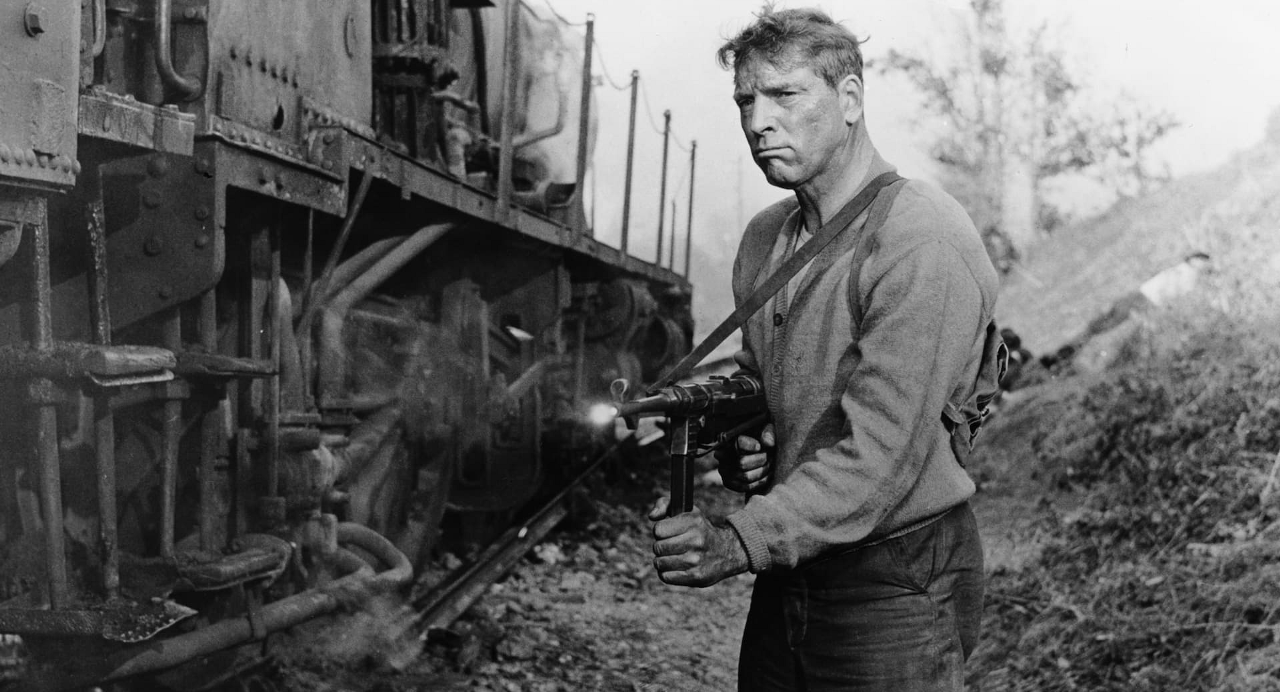
 Kino Lorber has released both 1964’s The Train and 1974’s Thunderbolt and Lightfoot on 4K UHD, while Criterion has released 1973’s Don’t Look Now in the format.
The Train was conceived by recent Oscar nominee Arthur Penn to be his follow-up to his Oscar-nominated The Miracle Worker. He directed the first day’s filming but was fired by United Artists the next day at the insistence of the film’s star, Burt Lancaster.
Lancaster, still riding high following his Oscar win for 1960’s Elmer Gantry and Oscar nomination for 1962’s Birdman of Alcatraz, was upset with the box-office failure of his 1963 film, The Leopard, which he blamed on the film’s lack of action. He did not like Penn’s lowkey approach to the film about the real-life resistance to the theft of French art treasures by the Nazis toward the end of World War II. He had him replaced by John Frankenheimer who had directed him in Birdman of Alcatraz and the recently completed Seven Days in May with The Manchurian Candidate in-between.
Released in London in December 1964, the film was not released in the U.S. until March 1965 at the same time as The Sound of Music. It became one of the year’s biggest hits, although its success wasn’t anything near that of the Rodgers and Hammerstein musical which dominated the year’s box-office receipts around the world.
Lancaster plays the French railway superintendent who tries to hold off the German train under the control of the Nazis led by Paul Scofield from leaving Paris awaiting the arrival of the Allies. Tired of waiting for the Allies to show up, he takes action of his own.
In addition to Scofield, who would soon achieve international screen success and win the 1966 Best Actor Oscar for that year’s Oscar-winning film, A Man for All Seasons, the film’s principal supporting players also include Jeanne Moreau (Jules and Jim) as a well-to-do hotelier, Suzanne Flon (Moulin Rouge) as a railroad official, and Michel Simon (The Two of Us) as the train’s conductor. Nominated for an Oscar for Best Original Screenplay, it lost to Darling.
The newly remastered release includes two commentaries on the 4K disc, one of which is the previously recorded one by Frankenheimer, as well as a wealth of extras on the accompanying upgraded Blu-ray.
Clint Eastwood’s production of Thunderbolt and Lightfoot was to have been Eastwood’s fourth film as director but at the last minute gave the reins to Michael Cimino whose rewrite of the screenplay for Eastwood’s 1973 film, Magnum Force, he greatly admired. It would be Cimino’s first film as a director.
Vaguely based on Douglas Sirk’s 1955 film, Captain Lightfoot, in which Rock Hudson (Lightfoot) and Jeff Morrow (Thunderbolt) played Irish rebels in the early 19th century, Eastwood’s bank robber is called Thunderbolt while his young accomplice, played by Jeff Bridges, is called Lightfoot. At one point in the film in which Bridges’ character is disguised in drag, Eastwood’s Thunderbolt calls Bridges’ Lightfoot, “Louise.” This is thought to have been the inspiration for 1991’s Thelma and Louise in which Susan Sarandon and Geena Davis play female bank robbers.
The film was not initially as successful as Eastwood thought it should be, which he blamed on United Artists’ marketing of the film which caused him to part ways with U.A. and look to Warner Bros. for future support.
The film earned Bridges the second of his eventual seven Oscar nominations, his first since 1971’s The Last Picture Show, and his last until 1984’s Starman ten years later. He lost to Robert De Niro in The Godfather Part II.
The supporting cast includes George Kennedy (Cool Hand Luke), Geoffrey Lewis (Every Which Way but Loose, Gary Busey The Buddy Holly Story, and Dub Taylor (You Can’t Take It with You).
Cimino’s next film would be 1978’s The Deer Hunter, the Oscar-winning film for which he won Best Director. His next film after that would be the disastrous 1980 film, Heaven’s Gate, in which Bridges is eighth billed in a cast led by Kris Kristofferson and Christopher Walken. One of the most notorious flops of all time, it all but ended Cimino’s career. Only his next film, 1985’s Year of the Dragon, proved mildly successful. He only directed four more films before dying in 2015.
The newly remastered release features commentary from critic Nick Pinkerton on the 4K disc along with a wealth of extras on the accompanying upgraded Blu-ray.
Based on a story by Daphne Du Maurier (Rebecca), Nicolas Roeg’s third directorial film, Don’t Look Now, is about a grieving couple led by a blind psychic to believe that she can “see” their recently deceased daughter.
The couple, played by Julie Christie and Donald Sutherland, have relocated to Venice where Sutherland has been commissioned to restore an ancient church. After meeting with the psychic, they have passionate sex in one of the most explicit sex scenes ever shown in a mainstream film.
Christie had worked with Roeg before. He had been the cinematographer on three of her previous films, 1966’s Fahrenheit 451, 1967’s Far from the Madding Crowd, so although terrified, she completely trusted him when he had her and Donald Sutherland who had just met, film the sex scene first.
The scene, for which only Christie, Sutherland, Roeg, and cinematographer Anthony Richmond were present, took all day. It had been rumored for years that the sex was not simulated even though all concerned vehemently denied the assertion. Warren Beatty, who was Christie’s boyfriend at the time, even punched Roeg out over one of the rumors.
More popular in the U.K. than the U.S., the film was nominated for seven BAFTAs including Best Film, Actor, Actress, Director, and Cinematography, which it won.
The 4K digital restoration was supervised by cinematographer Richmond. The accompanying Blu-ray disc features the usual plethora of extras from Criterion.
Happy viewing.


















Leave a Reply