
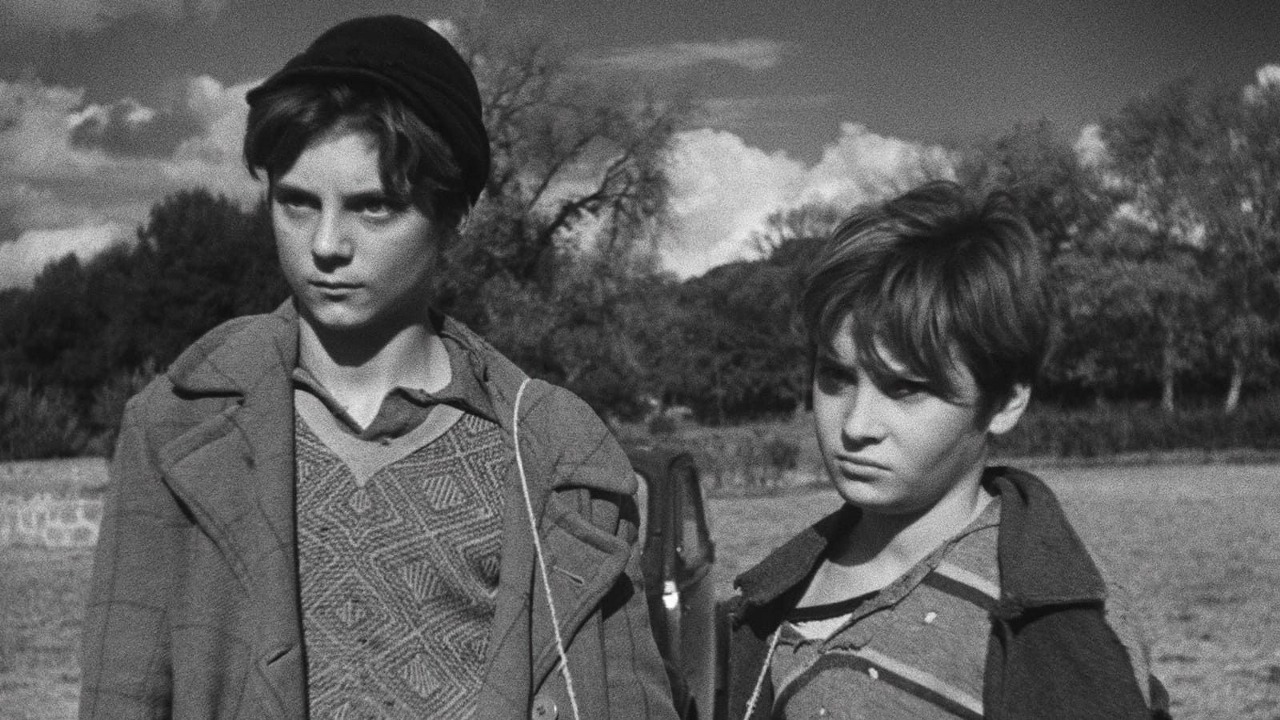
 The Criterion Collection has released a beautifully restored version of Vittorio De Sica’s Shoeshine on 4K UHD.
A seminal film of Italian neorealism filmed just after the end of World War II, Shoeshine was released in Italy in 1946 a year after Rome, Open City which had been a huge hit. However, with American films now the rage in Italy, audiences did not want to see a semi-documentary that exposed the suffering of children separated from their parents in their midst. It was not until the film was released outside of the country that it became recognized as the masterpiece that it was.
The National Board of Review named it as the third best film of 1947 behind behind Monsieur Verdoux and Great Expectations, and ahead of Crossfire, Boomerang! , Odd Man Out, Gentleman’s Agreement, To Live in Peace, It’s a Wonderful Life, and The Overlanders.
The New York Film Critics nominated it for Best Foreign Film but gave their award to the other Italian film on the NBR’s list, To Live in Peace, a comedy about American soldiers hiding from the fascists toward the end of the war. That film has been all but forgotten in the U.S. and is only available on a Spanish DVD in Italian with subtitles in Italian and Spanish.
Shoeshine went on to become the first film to win an Oscar for Best Foreign Film, an honorary award at the time. Its citation read “The high quality of this Italian-made motion picture, brought to eloquent life in a country scarred by war, is proof to the world that the creative spirit can triumph over adversity.”
De Sica’s film focuses on the plight of two 12-year-old boys who work as shoe-shine boys in the streets, who earn additional money as runners for the black marketers to earn enough to buy an old horse. They run afoul of the authorities and are arrested for a crime they didn’t commit and sent to a notorious prison for juvenile delinquents just after purchasing the horse for which they now need money to pay for its keep.
Their loyalty to each other is severely tested in the confines of the prison. De Sica, working as he often did with non-professional actors as well as experienced ones, immediately cast untrained actor Rinaldo Smordoni as Giuseppe, the smaller of the two boys while taking his time to cast Franco Interlenghi as his friend Pasquale. Interlenghi had been the immediate choice of producer Paulo William Tamburella who picked him at his first audition. Both actors are extraordinary, comparable to the child actors who excelled in early 1930s Hollywood films. Two others, Anneilo Mele as the sickly Raffaele and Bruno Ortensi as the bullish Archangel also stand out in the large cast.
The boys face one setback after another, culminating in an escape during a riot which leads to a devastating conclusion.
Only the film itself appears on the 4K UHD disc. An accompanying standard Blu-ray also features the film as well as several extras, most notable of which is a 2016 documentary, Shoeshine 70 featuring interviews with De Sica’s daughter Emi who died in 2021 at 83, along with producer Tamburella’s grandson, and the two stars of the film who are interviewed separately.
Smoldoni made two more films in the late 1940s and did some stage work but worked as a bus driver for most of his life. Interlenghi was a long-time actor and writer who at one time was expected to have as high profile a career as Marcello Mastroianni but never quite made it.
The film opens and closes on Smoldoni who is first seen getting out of a car in front of the prison that provided the exterior for the film – interiors were filmed on a soundstage. It ends with him sitting down with Tamburella’s grandson who leaves the table after speaking with him for some time and returns with the Oscar his grandfather won for producing the film which he gives the then 83-year-old Smoldoni to hold, which brings him to tears.
Interleghi died shortly after completing the documentary at 83. Smoldoni died in 2024 at 91.
The documentary is almost as good as the film itself.
Universal has released a 4K UHD version of 1950’s Harvey along with a reissue of the previously released standard Blu-ray. The release in unusual in that all the extras from the previous release also appear on the 4K UHD.
The film version of the Pulitzer Prize-winning play was a huge hit, earning James Stewart his fourth Oscar nomination, his first since 1946’s It’s a Wonderful Life.
Stewart had played the role of the good-natured alcoholic with a six-foot three-inch rabbit friend that only he can see on the London stage and briefly on Broadway where he filled in for vacationing Frank Fay briefly in 1947. Josphine Hull, who won an Oscar for playing Stewart’s long-suffering sister, had created the role on the stage in 1944. 1944 was the year of the release of Hull’s only other major film, Frank Capra’s Arsenic and Old Lace in which she and Jean Muir play Cary Grant’s dotty old aunts.
Stewart and Hull’s nominations were the only ones the film received.
Helen Hayes starred opposite Stewart in a highly successful revival of the play on Broadway in 1970, the year of Hayes’ Oscar-winning performance in Airport. Stewart and Hayes reprised their roles for an equally successful 1972 Hallmark Hall of Fame TV production.
Extras include documentaries on the first 100 years of Universal, one on the Carl Laemmle era and the other on the Lew Wasserman era.
Laemmle was a German emigree who got his start in nickelodeons, came west and built Hollywood’s first studio in the 1920s, one of its features being studio tours for tourists later revived by Wasserman in the 1950s and still going strong today.
Laemmle made annual visits back to Germany until the rise of the Nazis in 1931 after which he successfully got more than 300 families out of the country and into jobs in his studio. In the early 30s, his son, Carl Laemmle< Jr. took over, producing All Quiet on the Western Front, Imitation of Life and the Universal horror films that kept the studio rolling until the Deanna Durbin musicals came along to bring in more money.
Wasserman was originally an actor’s agent who became head of the studio and expanded its involvement into television as well as reviving the studio tours with the help of one of his TV stars, Alfred Hitchcock, who starred in a series of TV ads for the tours.
Happy viewing.















Leave a Reply