
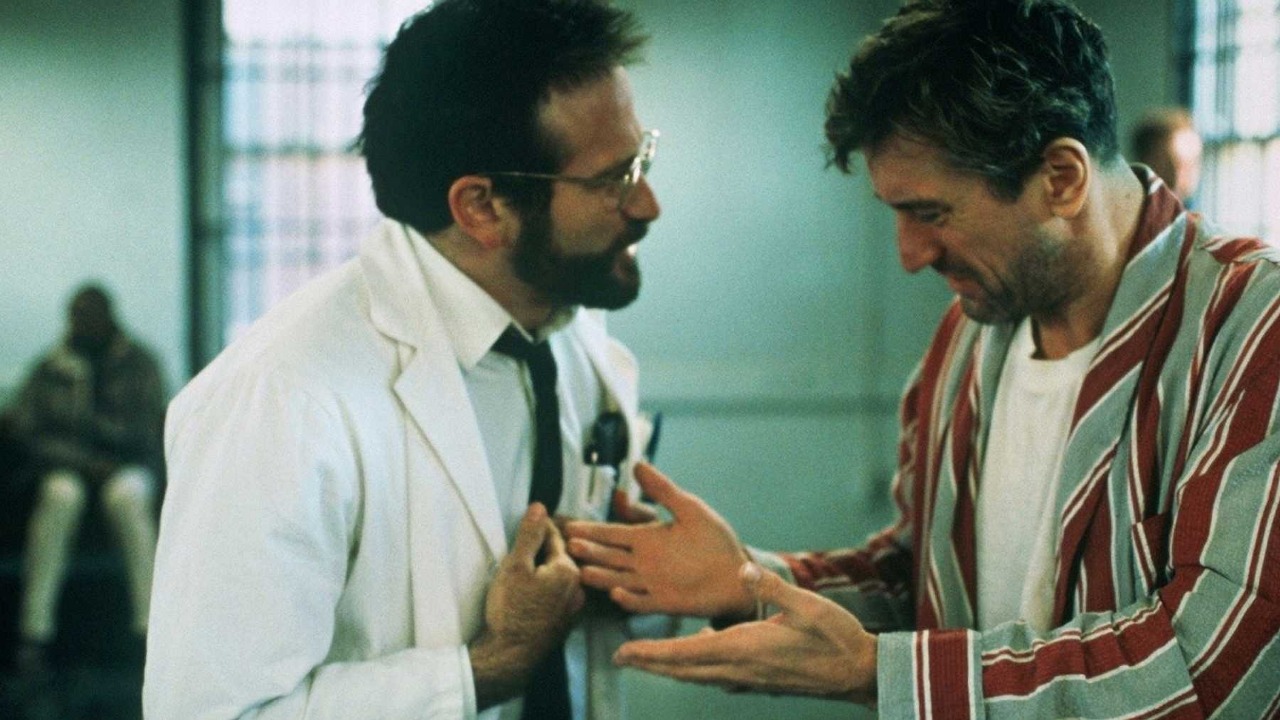
 Newly released on 4K UHD are some of the best remembered films released at the end of the 20th century and beginning of the 21st. They include 1990’s Awakenings, 1997’s Boogie Nights, 2002’s Minority Report and Catch Me If You Can, and 2005’s Jarhead.
Penny Marshall’s 1990 film, Awakenings was nominated for three Oscars, Best Picture, Actor (Robert De Niro), and Adapted Screenplay by Steven Zallian three years before he won his Oscar for turning in the same category fosr Steven Spielberg’s Schindler’s List.
Based on the autobiography of Oliver Sachs, M.D., a pioneering neurologist who miraculously awakened patients suffering from encephalitis from their perpetual catatonic states by treating them with a drug used for Parkinson’s Disease. Sadly, the awakenings were only temporary.
De Niro, in the same year in which he played one of his most memorable gangster roles in Martin Scorsese’s GoodFellas, played one of the awakened patients opposite Robin Williams in one of his best performances as Dr. Sachs. Standouts in the supporting cast include Julie Kavner as a caring nurse, veteran actress Ruth Nelson as DeNiro’s mother, and Judith Molina and Anne Meara as two of De Niro’s fellow sufferers. John Heard is the film’s principal villain as a doctor skeptical of Sachs’ abilities.
Marshall started out as an award-winning actress in the TV series, LaVerne and Shirley. She was the sister of director Garry Marshall who directed that year’s Pretty Woman for which Julia Roberts received a Best Actress nomination. She was also the former wife of award-winning TV actor turned director Rob Reiner who directed that year’s Misery for which Kathy Bates won the Best Actress Oscar over Roberts.
Paul Thomas Anderson’s 1997 film, Boogie Nights was nominated for three Oscars, Best Supporting Actor (Burt Reynolds), Supporting Actress (Julianne Moore), and Original Screenplay for Anderson. It became the first of Anderson’s 13 nominations to date with 2 more almost certain to follow for 2025’s One Battle After Another.
Anderson’s 2 hour and 35-minute film follows an adult film star played by Mark Wahlberg over a six-year period from 1977 through 1982 who quickly rises to the top of the game and just as quickly descends into a nightmare fueled by drugs and bad decisions.
Reynolds as Wahlberg’s director and Moore as his frequent co-star and off-screen mother figure are just two of the other outstanding players in the film. Heather Graham, John C. Reilly, and Thomas Jane as Wahlberg’s fellow adult film stars, Don Cheadle as an enterprising stereo salesman, and William H. Macy and Philip Seymour Hoffman as other members of Reynolds’ entourage also turn in memorable performances.
Anderson’s next big hit was 1999’s Magnolia.
Steven Spielberg frequently releases two disparate films in one year such as the science-fiction classic, Jurassic ParkSchindler’s List in 1993. His two 2002 releases, the 2 hour and 25-minute science-fiction film, Minority Report and the two hour and 21-minute biographical Catch Me If You Can are also complete opposites. The former is a science-fiction epic, while the latter is a comedy-drama based on a real-life character.
Minority Report is set in what was then 52 years in the future in which murders in a major metropolitan city have been eliminated due to the intervention of a unique police force that is alerted to impending murders by a team of precogs – a young woman and a pair of young male twins – who see what is to come if it isn’t stopped.
As the program is about to extend to the entire country, the program’s chief prevention enforcer (Tom Cruise) comes under scrutiny as a potential murderer and goes undercover to prove his innocence. An outside enforcer (Colin Farrell) is brought in to hunt Cruise down. The precog woman (Samantha Morton) is either kidnapped or freed by Cruise and helps solve the case. Max von Sydow as the director of the program and Lois Smith as the developer of the program provide interesting support.
The film’s sole Oscar nomination was for its sound.
Catch Me If You Can is based on the true story of Frank Abagnale, Jr., played by Leonardo DiCaprio, who from the age of 17 to 19, was a skilled forger who successfully posed as a doctor, lawyer, and airline pilot.
The film was nominated for two Oscars, Best Supporting Actor Christopher Walken as DiCaprio’s exasperated father and Best Score for John Williams who also composed the score for Minority Report and many other Spielberg films.
DiCaprio provides one of his finest performances but Tom Hanks who co-stars as the FBI agent who hunts him down, is way over the top in one of his worst performances. Amy Adams, in one of her earliest roles, stands out as wealthy Martin Sheen’s daughter, the girl DiCaprio almost marries. It was made into a successful Broadway 2010 musical starring Aaron Tveit in DiCaprio’s role.
Sam Mendes’ 2005 film, Jarhead, which takes place during Desert Storm, was the only war movie from the Oscar winning director of 1999’s American Beauty until his second Oscar nomination for Best Director of 2019’s 1917. It starred Jake Glyllenhaal who received an Oscar nomination for the same year’s Brokeback Mountain.
Although the film received no Oscar nominations, it did bring Gyllenhaal a Satellite nomination for Best Actor as well as a Supporting Actor nomination for his real-life brother-in-law, Peter Saarsgard who played his marine buddy in the film. Jamie Foxx, who won the previous year’s Oscar for Best Actor for portraying the legendary Ray Charles in Ray, was also a standout in the film as Gyllenhaal and Saarsgard’s staff sergeant.
Among recent theatrical films newly released on Blu-ray, is Sarah Friedland’s Familiar Touch for which Kathleen Chalfant won the National Society of Film Critics award for Best Actress.
80-year-old Chalfant plays a retired cook suffering from dementia who is doing her best to get through her everyday life in a memory care facility. What is unique about the film is that unlike most films about dementia, is that it is not about how the disease affects everyone around the patient, but how the patient herself sees things. Having no memory of her past days or any dreams about the future, she merely exists in the often-terrifying present. It’s like visiting a loved one in such a facility. It’s strangely both sad and uplifting at the same time.
Happy viewing.





















Leave a Reply