
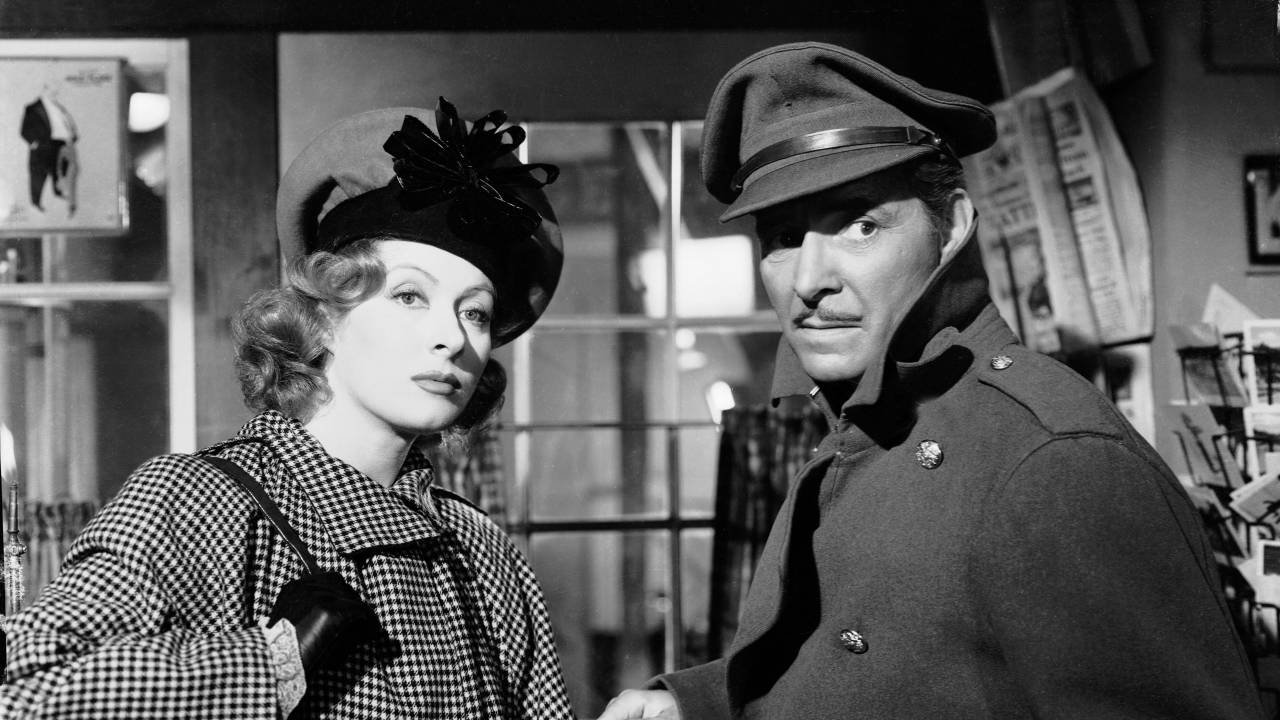
 Random Harvest, the beloved 1942 film which had long been one of Warner Archive’s most requested upgrades to Blu-ray, has finally been released in the format.
Based on the best-selling novel by James Hilton whose Lost Horizon and Goodbye, Mr. Chips had previously been made into equally beloved films, this one’s success equaled that of Mrs. Miniver, for which he co-wrote the screenplay, released earlier in the same year.
Mrs. Miniver had its world premiere at Radio Music Hall on June 4, 1942 in an era when films traditionally played the mammoth theatre for two to three weeks. It was such a huge hit that it ran for 12 weeks before leaving the theatre, causing other films scheduled to play there to either be delayed or rebooked into another Manhattan theatre. Random Harvest opened at the Music Hall on December 17, 1942 as the year’s Christmas attraction. It, too, stayed for 12 weeks holding up the release of other films scheduled to open at the theatre.
Random Harvest stars Ronald Colman who led the cast of the 1937 film version of Hilton’s Lost Horizon and Greer Garson who made her screen debut opposite Robert Donat in the 1939 film version of Hilton’s Goodbye, Mr. Chips. Garson who had received an Oscar nomination for that role, was, of course, also the star of Mrs. Miniver for which she would win the Oscar on her third nomination following Goodbye, Mr. Chips and 1941’s Blossoms in the Dust.
The Academy recently made an Oscar rule change allowing actors to be nominated separately for more than one film in the same category. Garson’s performances in Mrs. Miniver and Random Harvest are often cited as the prime example of why the rule should be allowed. Although her stalwart English mother in Mrs. Miniver was an inspiration for American mothers as the U.S. becomes England’s ally in World War II, her performances in both films are among the finest of all time and in Random Harvest she also gets to kick up her heels in song and dance.
Garson plays an English song-and-dance performer in a small Scottish town in 1920 who befriends amnesiac Colman who has escaped from the asylum in which he was held after suffering injuries in World War I. With the authorities on his tail, the two escape to another Scottish village where their romance blossoms and they marry and have a baby boy.
Colman, now an established writer, journeys to London for a job interview where he is involved in a minor accident in which he receives a bump on his head. When he awakens from the accident, his earlier memory is restored and his time with Garson is forgotten.
Colman, it turns out, is the son of a wealthy manufacturer who has just died leaving him his house and his older brother the old man’s business which Colman then joins and turns into a bigger success than it had ever been. At the same time, he is being pursued by the teenage daughter of his sister’s widowed husband. Years pass, and the teenage girl, played by Susan Peters, is in her early twenties and the two are engaged to be married.
Garson reenters in one of the most exquisite audience-pleasing moments in film history. It is revealed that she searched desperately for Colman after he disappeared without luck. Then her baby died and she was depressed for a long time. It wasn’t until his picture appeared in a local paper that she was able to find him but with the support of his former psychiatrist from the asylum (Philip Dorn), she takes a job as his private secretary under a different name but does not reveal who she is. She must wait for him to remember on his own.
Peters, sensing that Colman will never really be hers as he is has never fully recovered from his lost years, leaves him. He becomes increasingly successful in his business with the help of Garson and eventually is made a knight and becomes a member of the House of Lords. At this point, he asks Garson to enter into a marriage of convenience which she does, still hoping that at some point he will wake up. After more years of hopelessness, she decides to take an extended trip to Argentina which he agrees to. She takes a side trip on her way to the docks in Southampton to visit the Scottish town where they met. At the same time, he has to make an emergency visit to a strike at one of the mills his company now owns, one that happens to be in the town where he and Garson lived before his disappearance.
Will he finally remember his lost years? Of course he will. Have a supply of tissues ready as you watch the ending.
Mrs. Miniver received twelve Oscar nominations and six wins including Best Picture, Director for William Wyler, Actress for Garson, Screenplay for Hilton and three others, Supporting Actress for Teresa Wright, and Cinematography.
Random Harvest received seven Oscar nominations including Best Picture, Director for Meryn LeRoy, Actor for Colman, Supporting Actress for Peters, Screenplay, Art Direction, and Scoring, but failed to win any.
Also receiving new Blu-ray upgrades from Warner Archive are 1935’s A Midsummer Night’s Dream, 1938’s The Sisters, 1943’s Presenting Lily Mars, 1944’s The Seventh Cross, and 1952’s Macao.
A Midsummer Night’s Dream, directed by Max Rheinhardt and William Dieterle. is the film version of Rheinhardt’s overblown stage production of Shakespeare’s comedy that American audiences of the day loved and English audiences hated. Today’s audiences agree strongly with the latter. The film looks impressive but none of the actors including James Cagney, Joe E. Brown, Dick Powell, Olivia de Havilland, and Mickey Rooney are at their best.
The Sisters, directed by Anatole Litvak, is a well-made film version of a popular novel of the day about three sisters and their various relationships with Bette Davis as the oldest of the girls. Unfortunately, Errol Flynn as her alcoholic husband pales in comparison to John Garfield’s role in the same year’s similar Four Daughters and the San Francisco earthquake, though impressive, is nowhere nearly impressive as the earthquake in MGM’s San Francisco two years earlier.
Presenting Lily Mars, directed by Norman Taurog, is a decent Judy Garland musical on the way to the following year’s Meet Me in St. Louis.
The Seventh Cross, directed by Fred Zinnemann, is a well-made but very depressing anti-Nazi drama with good performances from Spencer Tracy, Hume Cronyn, and Jessica Tandy.
Macao, directed by Josef von Sternberg, is the best of several films made by Robert Mitchum and Jane Russell for Howard Hughes at RKO.
Happy Viewing.





















Leave a Reply