
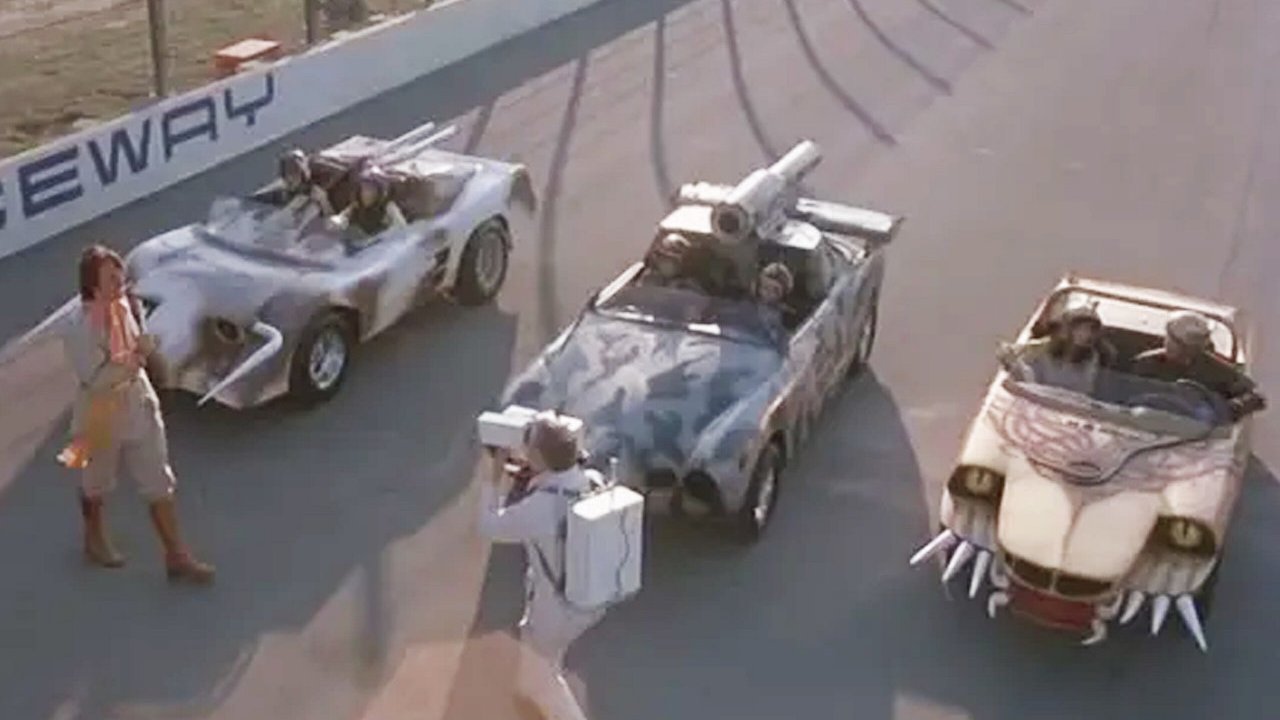
Death Race 2000
Rating

Director
Paul Bartel
Screenplay
Robert Thom, Charles Griffith (Story: Ib Melchior)
Length
1h 20m
Starring
David Carradine, Simone Griffeth, Sylvester Stallone, Mary Woronov, Roberta Collins, Martin Kove, Louisa Moritz, The Real Don Steele, Joyce Jameson, Carle Bensen, Sandy McCallum
MPAA Rating
R
Review
Before Mad Max envisioned a futuristic society built around societal collapse, Death Race 2000 established its own post-apocalyptic future with a vainglorious bloodsport at its heart.
After a ruinous economic collapse in 1979, the United States establishes an authoritarian ruling government headed by a man known simply as Mr. President (Sandy McCallum). As a panacea for the public’s insatiable need for distraction, a deadly cross-country road race is held annually with the film taking place during the event’s 20th anniversary. The racers include the mysterious, masked Frankenstein (David Carradine); Joe Viterbo (Sylvester Stallone), a Chicago gangster-coded driver; cowgirl Calamity Jane (Mary Woronov); Neo-Nazi Matilda the Hunt (Roberta Collins); and Nero the Hero (Martin Kove), a Romanesque gladiator.
A resistance group led by Thomasina Paine (Harriet Medin) plots to use the event’s winner as a political tool to assassinate the president with an assist from Frankenstein’s navigator, Annie Smith (Simone Griffeth). Robert Thom and Charles Griffith’s screenplay based on the short story “The Racer” (1966) by Ib Melchior has patently predictable plotting with story beats accentuated by ultraviolence. The racers gleefully murder innocents for bonus points, including nurses, children, and the elderly. Director Paul Bartel captures the insanity frugally with nary a stylistic flourish. Perhaps if producer Roger Corman had directed the film instead, it might have felt more consequential.
Carradine plays the stoic Frankenstein as ably as possible with a narrative as gimmicky as this. The rest of the drivers, including a pre-Rocky Stallone, are one-note caricatures of the kinds of racecar drivers popularized in films like Grand Prix in 1966. Even the resistance members fail to register as more than periphery characters to the violence on screen. This type of action is common in sci-fi narratives as exemplified by the aforementioned Mad Max and Stanley Kubrick’s A Clockwork Orange.
Apart from its creative application of vehicular slaughter across its length, the film is surprisingly unexceptional. Film history is filled with films like this and while the movie didn’t spawn the copycats some others did, it remains a time capsule of the kind of blunt-force sermonizing that characterized Cold War era anti-Communist themes. Many great directors tackled the subjects with aplomb but while they had a high-minded audience in mind, movies like this spoke better to low-brow viewers who wanted to see wholesale slaughter without having to think too deeply about its premise.
Even then, it’s impossible not to get the hint of the anti-fascist concept at the heart of the film. Death Race 2000 is a cult favorite for its unique depiction of futuristic bread and circuses events that showcase the need for dictators and authoritarians to distract the populace from their curtailed freedoms and economic woes with entertainment. In a modern context, the film carries renewed meaning, yet it remains a kitschy concept executed simplistically but worth catching for its ultimately unique sci-fi concept.
Review Written
September 24, 2026



















Leave a Reply