
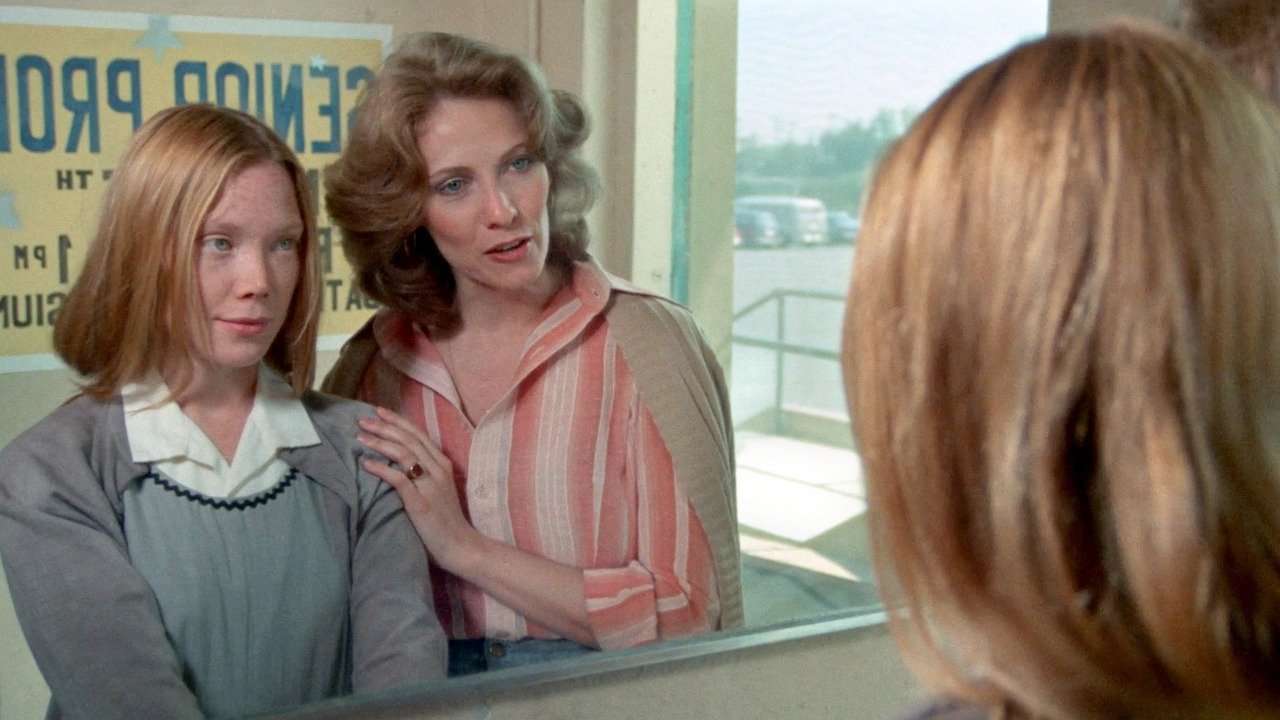
Carrie
Rating

Director
Brian De Palma
Screenplay
Lawrence D. Cohen (Novel: Stephen King)
Length
1h 38m
Starring
Sissy Spacek, Piper Laurie, Amy Irving, William Katt, John Travolta, Nancy Allen, Betty Buckley, P.J. Soles, Priscilla Pointer, Sydney Lassick, Stefan Gierasch, Michael Talbott
MPAA Rating
R
Review
Toxic high school experiences are par for the course in the United States but horror as a treatment on bullying and antisocial behavior is a unique offering that Carrie provided.
Based on the Stephen King novel of the same name, Carrie revolves around an awkward teenager (Sissy Spacek) whose religious upbringing helps diminish her self-esteem, making it difficult for her to make friends at school where her conservative attire and sheepish behavior engender taunting, teasing, and harassment that far exceeds the already tense environment. Although a gym teacher (Priscilla Pointer) does stand up for her, the bully (Nancy Allen) making Carrie’s life miserable won’t stop at a scolding, especially since she blames Carrie for the punishment. With her unforgiving and abusive mother (Piper Laurie) compounding the situation, her latent telekenetic powers will prove useful in exacting her initially unintended revenge.
The impact of a film like Carrie can be felt in the near term but that it remains as relevant today as it did almost 50 years ago is a testament to the message it sends. Not a message of revenge against those who oppress or mistreat you but in its exploration of the onerous nature of bullying, its pervasive tolerance, and the struggle not to respond with commensurate payback. The film doesn’t just target teenagers whose hormonal impulses are difficult to rein in but also adults with insidious beliefs that strip away the kindness and compassion that are needed to overcome such assaults on the psyche.
Deserving of their Oscar nominations, Spacek and Laurie are superb in roles that seemed tailor made for their talents. Spacek plays the meek, self-conscious Carrie and conveys her mental frailty and subtle shifts in mood, but delivers in the simmering moments of quiet range, a believable advancement and transition of character personality. While Laurie doesn’t have the grand character arc of Spacek, she presents Margaret White’s fanatical devotion to a god who sees retribution as imperative, especially with unrestrained teens whose baser instincts will lead them astray. Her aggressive and vicious treatment and rebukes of her daughter are a chilling reminder that parents can be, even in this extreme, bigger bullies than classmates.
Although the film wasn’t the first horror film set on an American high school campus (that was 1957’s I Was a Teenage Werewolf), it was the second and perhaps the most pivotal. It was part of a 1970s shift towards blood-soaked horror entertainment that saw films like Suspiria, Halloween, and Texas Chainsaw Massacre dominate the genre and usher in the preponderance of ’80s schlock horror. Some might not see that as a positive considering how overboard filmmakers went with it but there’s no question that from 1970 through 1985 or so, the horror genre was at his most gruesome and arguably best.
Audiences today might think of Carrie as being a little tame by modern standards but it carved a path for teensploitation horror in a way that blurred the line between social commentary and bloody schadenfreude. Were its successors entirely successful in living up to its goals? Some were but many weren’t and that further helps Carrie stand out as an impressive milestone for 1970s horror.
Review Written
July 22, 2025













Leave a Reply