
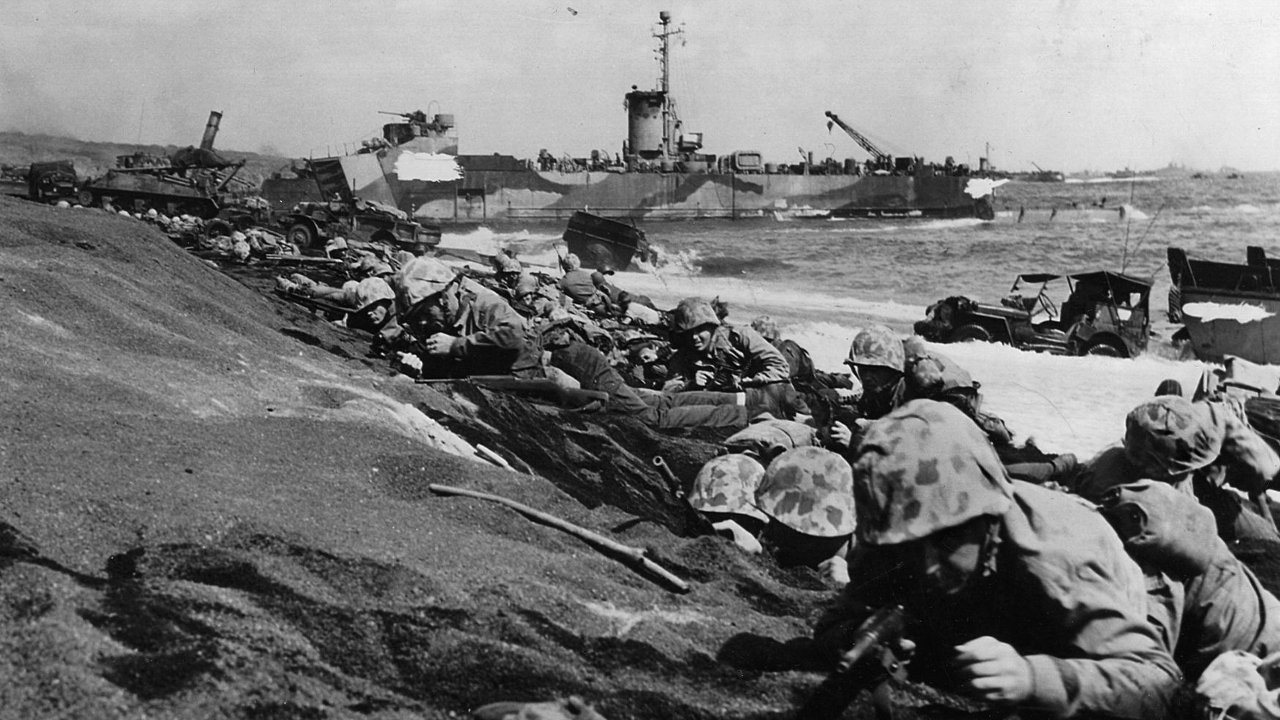
 Kino Lorber has released 4K UHD updates of two atypical John Wayne films, 1949’s The Sands of Iwo Jima and 1963’s Donovan’s Reef, both of which he initially turned down.
Best known for his cowboy roles starting with 1930’s The Big Trail, Wayne starred in some of the most iconic westerns of all time including 1939’s Stagecoach, 1948’s Red River and Fort Apache, 1949’s She Wore a Yellow Ribbon, 1950’s Rio Grande, and 1956’s The Searchers. All of those, except for Red River, were directed by his mentor, John Ford.
Ford also directed Wayne in two of his most acclaimed non-westerns, 1945’s anti-war classic, They Were Expendable and the 1952 comedy classic, The Quiet Man. Sands of Iwo Jima, directed by Allan Dwan, and Donovan’s Reef, his last film for Ford, return him to those genres.
Sands of Iwo Jima is both a war movie and an anti-war movie. Director Allan Dwan (1885-1981) made 415 films between 1911 and his retirement in 1961. His best remembered films, other than this, were the Shirley Temple classics of the late 1930s, Heidi and Rebecca of Sunnybrook Farm, and the mid-1940s stage adaptations of the comedies, Up in Mabel’s Room and Getting Gertie’s Garter. Sands of Iwo Jima was his only war movie.
War movies made during World War II were mostly propaganda films that served as recruiting tools for young men. More realistic looks at the downside of war did not emerge until the release of They Were Expendable and Lewis Milestone’s A Walk in the Sun in December 1945. Then they completely disappeared, re-emerging with four strong war/anti-war films in 1949 beginning with Home of the Brave in May and ending with Twelve O’Clock High, Battleground, and Sands of Iwo Jima, all released in December.
Battleground and Twelve O’Clock High were Oscar nominees for Best Picture and Gregory Peck in Twelve O’Clock High and Wayne in Sands of Iwo Jima were nominated for Best Actor. It would be Wayne’s only nomination until True Grit for which he won twenty years later.
Wayne initially turned down the role of the tough sergeant in the film because he felt he was too old at 42 to realistically play the part and because he thought the public had had its fill of war films. While he appreciated being nominated for an Oscar for the role, he felt that if he were nominated that year, it should have been for She Wore a Yellow Ribbon.
The film, which follows a platoon of soldiers through the battles of Tarawa and Iwo Jima, was a rare A-picture for Republic Studios. It was made with one thing in mind, to end the film with the iconic planting of the American flag at the top of the hill on Iwo Jima, featuring the surviving three men who planted it and three actors representing the men who didn’t make it.
The film’s superb cast included John Agar, Forrest Tucker, Wally Cassell, James Brown, Richard Webb, Arthur Franz, Richard Jaeckel, and real-life survivors of the battle of Iwo Jima, Rene A. Gagnon, Ira H. Hayes, and John H. Bradley. The three were played, respectively, by Jesse Bradford, Adam Beach, and Ryan Philippe in Clint Eastwood’s 2006 film, Flags of Our Fathers. Tony Curtis played Hayes in 1961’s The Outsider directed by Delbert Mann.
Donovan’s Reef has long been a misunderstood film, mainly due to the film’s narrative which doesn’t explain anything, it just shows it. Credit goes to John Ford’s biographer Joseph McBride who sheds light on the film with his excellent commentary on the new release.
Wayne didn’t want to make it as he thought it ridiculous for him to be playing opposite the daughter of a contemporary character but he eventually gave in as he invariably did when Ford asked him to.
Beautifully filmed in Hawaii and taking place on a fictitious nearby Polynesian island, the film opens with a brawl between stars Wayne and Lee Marvin that makes no sense unless you know that it is the 22nd anniversary of the attack on Pearl Harbor. Wayne and Marvin have been commemorating that day with a brawl ever since.
Wayne and Marvin served with Jack Warden during the war. Warden, a widowed doctor, who also decided to stay on the island after the war, is the island’s only doctor. Choosing not to go back to Boston where he was the scion of a wealthy family with a young daughter being raised by his parents, he married the granddaughter of the last island king. They had three children together, his wife dying in childbirth during the birth of boy and girl twins. When his estranged Boston daughter announces that she is coming to the island to get her father to sign over his rights to the family fortune, the island’s bigoted governor (Cesar Romero) dictates that Warden’s interracial children live with Wayne so as not to embarrass Warden’s presumed uptight daughter.
Enter Elizabeth Allen, the film’s real star, as the daughter who is not bigoted at all, but warmly embraces Wayne’s pretend children, not knowing that they are her half-siblings. Complications arise and eventually work out with Allen falling in love with Wayne.
Allen, the original and-away-we-go girl on The Jackie Gleason Show, most famously played the Katharine Hepburn role in the 1965 Broadway musical version of Summertime, Richard Rodgers and Stephen Sondheim’s Do I Hear a Waltz?
What makes the film work beyond the beautiful locations are the performances of Ford’s stock company of fine actors including Dorothy Lamour who last worked with him in 1937’s The Hurricane, and the three children playing Allen’s half-siblings, Jacqueline Malouf, Cherylene Lee, and Jeffrey Byron.
Byron was Ford’s godson, the son of Anna Lee who appeared in such Ford films as How Green Was My Valley, Fort Apache, The Last Hurrah, and his last, 7 Women.
The veteran star of TV’s General Hospital from 1978 to 2003, her Daytime Lifetime Achievement Emmy for that was accepted by Byron a week after her death in 2004 at 91.
Happy viewing.
















Leave a Reply