
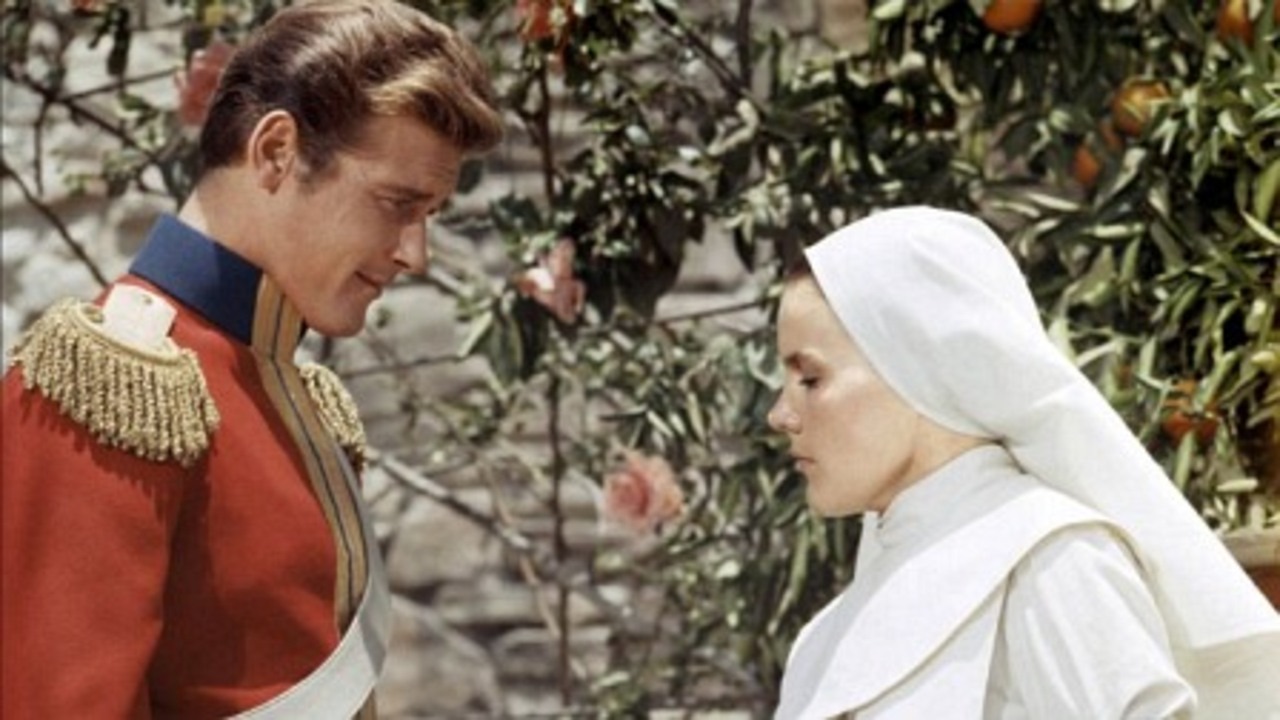
 Warner Archive has released the long sought-after restoration of 1959’s The Miracle on Blu-ray.
The film, which until now has only been available in faded bootleg DVD releases if you could find them, was the Radio City Music Hall Christmas attraction in 1959, a big deal at the time. The previous year’s Christmas attraction had been Warner Bros.’ production of Auntie Mame which went on to become the biggest box-office hit of 1959. Earlier in 1959, the Music Hall premiered Warner Bros.’ The Nun’s Story one of the most acclaimed films of the year and one of the most acclaimed films about a nun ever made. Another film from Warner Bros. about a nun seemed like another chance at critical and box office success for the venue.
Max Reinhardt’s stage production of The Miracle, which took place entirely in a medieval cathedral was presented all over the world beginning in 1911, reaching Broadway in 1924.
Based on a 12th Century Spanish legend, it was a wordless play about a wayward nun who leaves the convent to follow a soldier she has becomes infatuated with while the Virgin Mary aka the Madonna climbs down from her statue to take her place. It is therefore the statue that is missed, not the nun, until she returns and the Madonna climbs back on her pedestal.
The play was filmed as a black-and-white German film and a British color film, both in 1912.
Warner Bros. held the U.S. rights to the play which it originally intended to produce in 1942 with Bette Davis in the dual role of the nun and the Madonna, directed by Irving Rapper. Davis and Rapper made Now, Voyager instead.
It was later announced as a film with Jean Simmons as the nun and Stewart Granger as the soldier she leaves the convent for. A few years later it was offered to Natalie Wood who turned it down, and was finally filmed with Carroll Baker and Roger Moore, directed by Rapper following his direction of Wood and Gene Kelly in 1958’s Marjorie Morningstar. Rapper went on to direct such diverse films as The Christine Jorgensen Story and Mae West’s Sextette. He died in 1999 at 101.
Baker had become both famous and infamous as the thumb sucking bride in 1956’s Baby Doll for which she received an Oscar nomination for Best Actress. Despite having given memorable performances in Giant and The Big Country, Warner Bros. only wanted to cast her in roles like the one she played in Baby Doll. Baker refused all such roles, prompting Warner Bros. to ask her to pick something that she would be interested in. She chose The Miracle because she thought it was as far away from Baby Doll as she could get.
Dirk Bogarde was Warner’s choice to play the soldier, but he was busy with other projects and recommended Moore for the role.
Had the film stayed close to the play Baker may have accomplished her mission to stay clear of sexpot roles, but the screenplay veered in a different direction.
Only the opening and closing scenes of the film take place in the cathedral. Most of it follows Baker’s character as she goes from a gypsy camp to a bullring to a Flamenco dance troupe and other places initially in search of Moore who she is led to believe has been killed. She then goes from man to man before finally finding her soldier who in the meantime returns to the convent in search of her, only to be thwarted by the mother superior played by Isobel Elsom.
While these scenes away from the cathedral provide colorful scene chewing performances for the likes of Walter Slezak, Vittorio Gassman, and Katina Paxinou, they failed to thrill critics who still couldn’t see Baker as anything but the thumb sucking bride from Baby Doll. Audiences, however, were more tolerant and the film and became a moderate success, although not one nearly as popular as either Auntie Mame or The Nun’s Story.
Today’s more sophisticated audiences are likely to agree more with the critics of the day than audiences did but thanks to Warner Archive, the film is our there once again for everyone to judge for themselves.
Radio City Music Hall opened in 1931 as a venue for stage shows but did not make a profit until they changed to a movie and an accompanying stage show, a strategy that paid off for almost fifty years thereafter.
In the 1930s, Radio City Music Hall showcased such diverse classics as King Kong, Show Boat, and Snow White and the Seven Dwarfs, Holiday and Jezebel.
In the 1940s, they premiered such fondly remembered films as The Philadelphia StoryMrs. Miniver, Random Harvest, The Valley of Decision, and The Bells of St. Mary’s.
In the 1950s, they introduced us to such classic films as Seven Brides for Seven Brothers, White Christmas, I’ll Cry Tomorrow, Cat on a Hot Tin Roof, and North by Northwest in addition to the previously mentioned Auntie Mame and The Nun’s Story.
In the 1960s, they gave us Breakfast at Tiffany’s, The Days of Wine and Roses, To Kill a Mockingbird, Charade, and Mary Poppins all of which kept the Music Hall going as the showplace of the nation.
By the 1970s, however, audiences dwindled and the theatre that once entertained audiences with a wide variety of films now mostly catered to families with young children and turned down such films as Chinatown, Blazing Saddles, and The Godfather Part II that might have drawn wider audiences. By the end of the decade, facing bankruptcy, the theatre closed, reopening from time to time for special events such as its annual Christmas show featuring the Rockettes, and the sometimes home of the Tony Awards.
Until next time, happy viewing.



















Leave a Reply