
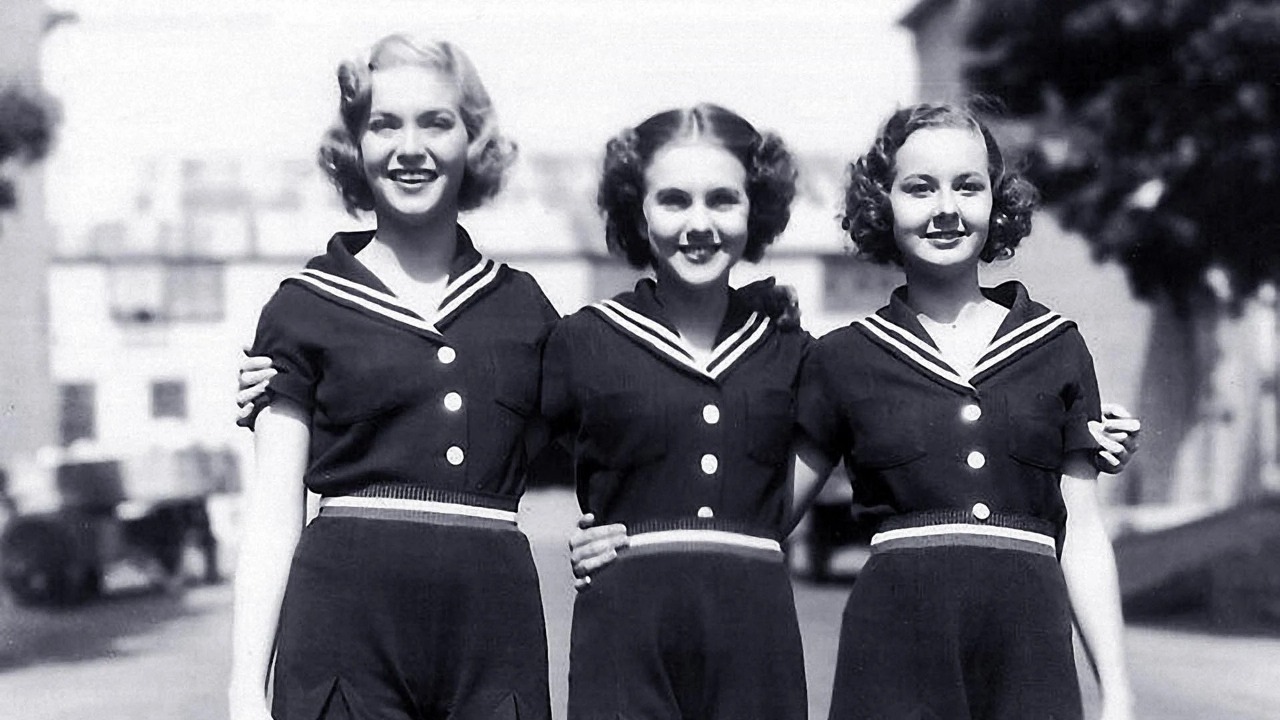
 Universal has finally released three of its most requested titles from 1936-1961 on Blu-ray.
First up is 1936’s Three Smart Girls, the first of the Deanna Durbin musicals that the studio released between 1936 and 1948, though not one of her best. Oddly enough, though, that the publicity generated by the studio was enough to earn it a Best Picture Oscar nomination over the studio’s far superior and far more successful definitive version of the musical, Show Boat.
Although classified as a musical, Three Smart Girls, unlike most of Durbin’s subsequent films, is more a screwball comedy than it is a musical. It features just three songs by the operatically trained singer, one that opens the film, one she sings halfway through and one that she sings near the end.
The film’s comedy isn’t all that remarkable either, though it was enough to get it nominated over the year’s classic screwball comedy, My Man Godfrey which was left off the 10-film Best Picture ballot despite acting nominations for four of its stars, William Powell, Carole Lombard, Mischa Auer, and Alice Brady. Auer and Brady are also in Three Smart Girls, Brady plays the conniving mother of Durbin’s divorced father Charles Winninger’s fiancé played by Binnie Barnes. Auer is a con man hired by Durbin’s friend to pretend to be rich to lure Barnes away from Winninger.
Nan Grey and Barbara Reed play Durbin’s sisters, completing the triumvirate forming the titled threesome. Ray Milland and John King are the young men who try to help Durbin bring Winninger to his senses. Nella Walker plays their mother and Lucile Watson their governess.
Henry Koster directed.
Extras include documentaries on Universal’s founder, Carl Laemmle and Lew Wasserman who revitalized the studio from the 1950s through the 1970s.
1954’s The Black Shield of Falworth was Universal’s first widescreen release, filmed in cinemascope under the direction of fabled cinematographer turner director Rudolph Maté.
Nominated five times for an Oscar for his cinematography on such films as Foreign Correspondent and The Pride of the Yankees, Maté’s films as a director are not as well regarded but were highly serviceable, as is this one.
The film has long had a bad reputation as the one in which Tony Curtis says ‘yondah lies da castle of my foddah’ but he never said that in this or any other film. He may have been miscast has the educated peasant who becomes a knight, but it doesn’t deter from the film’s stirring derring-do.
Cast opposite then wife Janet Leigh as his love interest and Barbara Rush as his sister, the actor comes through okay even if there are better performances in the film by the likes of Dan O’Herlihy, Herbert Marshall, David Farrar, Patrick O’Neal, Ian Keith, Torin Thatcher, and the lesser-known Craig Hill.
The film was Universal’s answer to MGM’s Knights of the Round Table and Warner Bros.’ King Richard and the Crusaders in the pantheon of swashbucklers released that year.
1961’s Romanoff and Juliet, written by, directed by, and starring Peter Ustinov is a surprisingly entertaining spoof on the cold war. Although nowhere near as good as Billy Wilder’s cold war spoof, One, Two, Three, also released that year, it was good enough to garner Ustinov a nomination for Best Director from the DGA in a year in which there were twenty-one nominees, none of whom were Wilder who had won the year before for The Apartment.
Ustinov’s competition included Robert Wise and Jerome Robbins who won for West Side Story. as well as Stanley Kramer for Judgment at Nuremberg, Robert Rossen for The Hustler, J. Lee Thompson for The Guns of Navarone who emerged as finalists, as well as Frank Capra for Pocketful of Miracles, Elia Kazan for Splendor in the Grass, Henry Koster for Flower Drum Song, Joshua Logan for Fanny, and William Wyler for The Children’s Hour among the also-rans.
Ustinov plays the president of a small country that holds a key vote at the UN with both the U.S. and the U.S.S.R. trying to persuade him to vote with them. Sandra Dee (Juliet) co-stars as the daughter of the U.S. ambassador to his country and John Gavin (Romanoff) plays the son of Soviet Akim Tamiroff whose elopement mirrors that of Shakespeare’s Romeo and Juliet albeit with a happier ending.
Ustinov’s Billy Budd would garner Terence Stamp an Oscar nomination in the title role the following year. Ustinov was himself a two-time Oscar winner for Best Supporting Actor for 1960’s Spartacus and 1964’s Topkapi.
Warner Archive’s late May releases included 1949’s Follow Me Quietly and 1977’s The Late Show.
Follow Me Quietly is a sturdy one-hour long B movie that was an early entry in the directorial career of former short film director Richard Fleischer, whose career would take a giant leap forward two years later with Narrow Margin and continue through such films as 20,000 Leagues Under the Sea and Soylent Green. It starred William Lundigan as a homicide detective and Dorothy Patrick as an up-and-coming reporter. Both had major roles in bigger 1949 successes, he in Pinky and she in Come to the Stable.
The Late Show, directed by Robert Benton. Starred Art Carney as a tired old private detective on his last case in a role for which he won the National Society of Film Critics award for Best Actor three years after winning a surprise Oscar for Harry & Tonto over Jack Nicholson in Chinatown and Al Pacino in Godfather II.
Carney is good but Lily Tomlin who was so good in 1975’s Nashville disappoints as his daffy client in her follow-up film, a type of character that seemed to be in every other film in 1977.
See it for Carney.
Happy viewing.


















Leave a Reply