
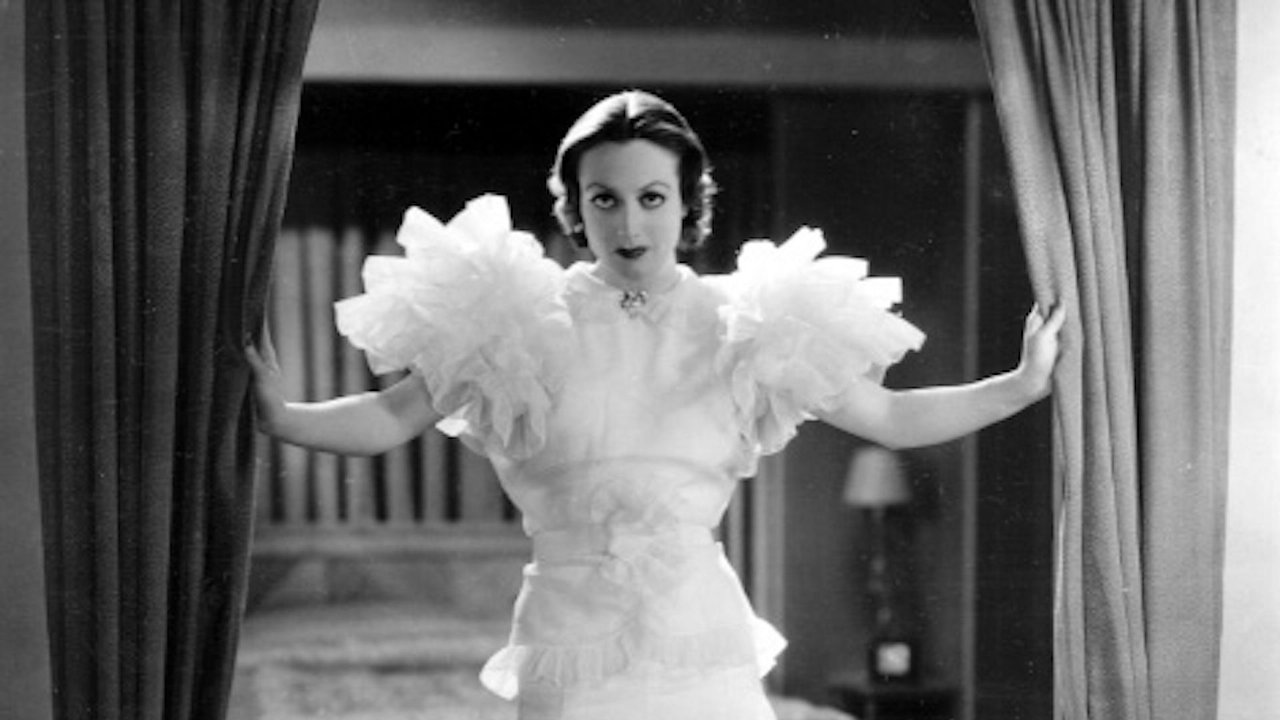
 Warner Archive’s impressive roster of June releases has finally been released after a delay of several weeks.
From 1932’s Letty Lynton to 1969’s Last Summer, these six new releases run the gamut from pre-code glamor to post-code realism and everything in-between from operetta to mysticism to war to show music.
Letty Lynton is of course the famous film that was withdrawn from distribution for 90 years beginning in 1936 due to a court awarded verdict of plagiarism against MGM for a film that had a plot too much like a stage play that was not credited. Ironically, the film couldn’t be shown during the Hollywood Code era from 1934-1967 anyway because it is about a murder that the film’s protagonist gets away with.
Joan Crawford is the protagonist, a spoiled rich girl who escapes the stranglehold of a brutish South American lover by taking a three-week voyage on a ship bringing her back to New York and her estranged mother played by May Robson.
Nils Asther is the brute, Louise Closser Hale the maid who accompanies Crawford on her voyage during which she has a shipboard romance with an equally spoiled rich guy played by Robert Momtgomery that leads to his marriage proposal. Asther meanwhile has figured out what she is up to and flies to New York where he meets the ship at the dock and forces his way back into her life.
Crawford puts off meeting Montgomery’s parents to meet Asther at his hotel where she plans to commit suicide in front of him. Instead, he picks up the drink laced with the poison that she planned to take herself and she does not stop him, thus committing murder. She is interviewed by suspicious District Attorney Lewis Stone, but there is a twist at the end which allows her to get away with it.
Crawford, who usually played women who went from rags to riches in her films plays a woman who is rich from the get-go and gets to wear some fabulously designed gowns by Adrian duplicates of which sold to those who could afford them during the Great Depression.
Clarence Borwn, Greta Garbo’s favorite director gets a very good performance from Crawford released the same year the same year as Grand Hotel which she stole from Garbo.
Extras include the previously released documentary on the life and career of MGM’s production chief Irving Thalberg.
1936’s Rose-Marie, directed by W.S. Van Dyke, is the second of three film versions of the 1924 operetta. The first was a 1928 silent version with Joan Crawford as the backwoods Canadian girl of the title. The third was a 1954 remake with Ann Blyth. This one starred Jeanettte MacDonald in a revamped version as a famous operetta star masquerading as the backwoods girl trying to get the Mounties led by Nelson Eddy to stop pursuing her brother, James Stewart, for a murder he didn’t commit.
As was the custom in Hollywood musicals of the day, the Rudolf Friml-Oscar Hammerstein II-Otto Harbach score was replaced by other songs except for “Totem Tom-Tom”, “Indian Love Call”, and the title song. A big hit in its day, it was surpassed both artistically and commercially by Jeanette’s next film, San Francisco opposite Clark Gable and Spencer Tracy.
1940’s Strange Interlude was the last of eight films that Joan Crawford made opposite Clark Gable in nine years. Directed by Frank Borzage (A Farewell to Arms, History Is Made at Night), the film is a romantic melodrama about a prison escape from Devil’s Island led by Gable with Crawford as his downtrodden lover. The couple is looked over by a mystical Christ figure played by Ian Hunter with Paul Lukas and Peter Lorre heading the supporting cast.
The film is an interesting one but far from the best that either Crawford, Gable or Borzage made during their celebrated careers.
Extras include a previously released documentary on Crawford and Gable.
1944’s Thirty Seconds Over Tokyo, directed by Mervyn LeRoy, starred Jeanette MacDonald’s other San Francisco co-star, Spencer Tracy as General Jimmy Dolittle whose raids turned the tide for U.S. victories in the Pacific during World War II. Told from the perspective of one of the pilots played by Van Johnson, the film is one of the better ones made during the war with standout performances from Johnson, Phyllis Thaxter as his wife, Robert Walker as his navigator, and Robert Mitchum as a fellow pilot.
1946’s Night and Day, directed by Michael Curtiz, did to Cole Porter what Rhapsody in Blue did to George Gershwin and Till the Clouds Roll By and Words and Music would soon do to Jerome Kern and Rodgers & Hart respectively, that is tell a heavily fictionalized story about a great contemporary composer’s life.
Like Robert Alda’s Gershwin, Robert Walker’s Kern, and Tom Drake and Mickey Rooney’s Rogers & Hart, Night and Day’s Cary Grant does a serviceable job as Porter but like the others his performance as well as his film lives in the shadow of James Cagney’s portrayal of George M. Cohan in 1942’s Yankee Doodle Dandy.
Alexis Smith is fine as Porter’s trophy wife and Monty Woolley is memorable as himself but Woolley, who was later a professor at Yale, was not Porter’s professor in real life but his fellow student, making the relationship between the two seem odd from the beginning.
The musical numbers are well done, especially “Begin the Beguine and the title song, with Jane Wyman a standout as a talented chorus girl. Mary Martin provides authenticity to playing herself, but soft-voiced Ginny Sims is a poor substitute for the dynamic Ethel Merman.
1969’s Last Summer, directed by Frank Perry, was the third most visible sign that Hollywood films had matured in the summer of 1969 behind Midnight Cowboy and Easy Rider. The beautifully restored film proves how wonderful Barbara Hershey, Richard Thomas, Bruce Davison, and the luminous Cathy Burns were in their youth.
Extras include an on-screen interview with Hershey and Davison in Santa Monica and a separate one with Thomas in New York. All three hyped praise on their Oscar nominated breakout co-star Burns who died in obscurity in 2019.
Happy viewing.


















Leave a Reply