
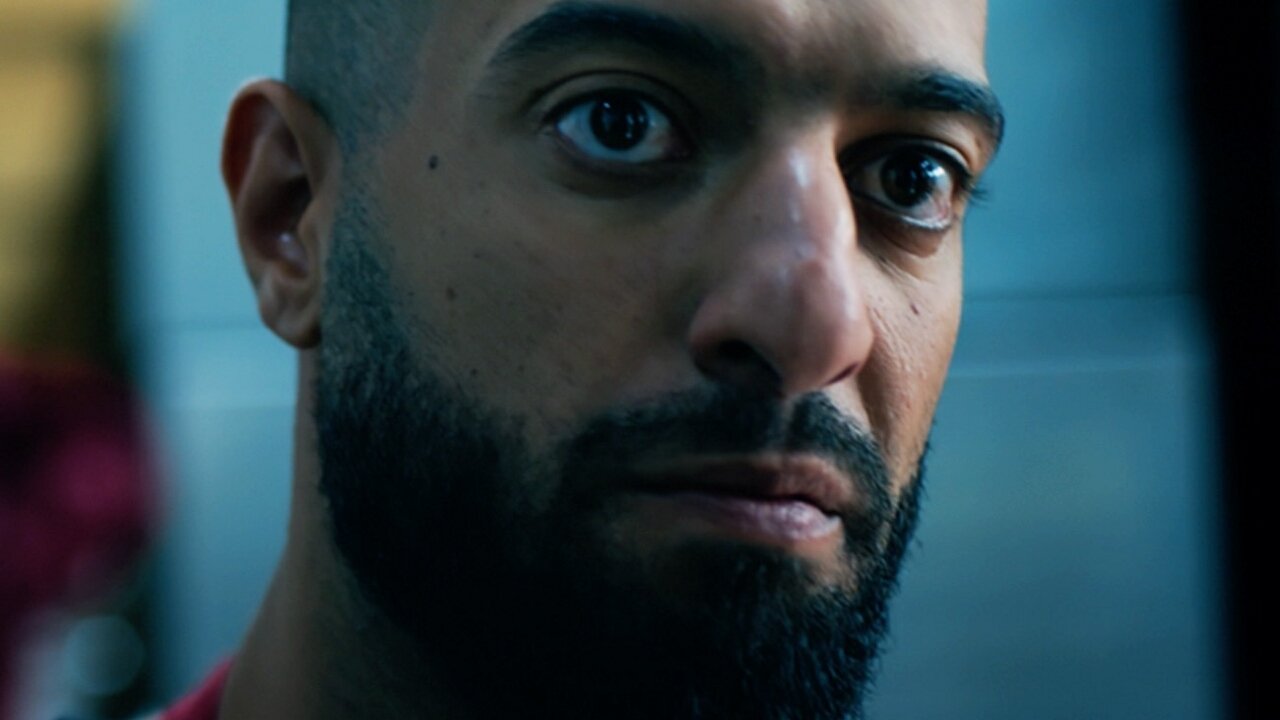
Butcher’s Stain (Short Film)
Rating

Director
Meyer Levinson-Blount
Screenplay
Meyer Levinson-Blount
Length
26m
Starring
Omar Sameer, Meyer Levinson-Blount, Rona Toledano, Dror Marko, Sara Raed, Eilon Cohen, Hadi Salama
MPAA Rating
Not Rated
Review
Working to support his son, Samir (Omar Sameer) is employed as a butcher at a supermarket in Tel Aviv, Israel. Well liked by his coworkers and the community, Samir struggles to meet his financial obligations while fighting with his ex-wife to see his young son. When an unknown coworker accuses him of tearing down a poster in the break room depicting hostages held by Hamas, as the only Arab Israeli employee in the supermarket, the subtle bigotry emerges as he discovers what his coworkers believe him capable of.
We’ve seen numerous short films out of Israel and Palestine about these types of situations, most of them are shocking in how seemingly rational people can believe the worst about their fellow humans and then act in a way that is harmful to targets of those beliefs. Butcher’s Stain presents Samir as a friendly, hard-working man whose religious beliefs are derided throughout the nation in which he lives. Surrounded by people who think so little of him begins to fray his once confident demeanor and the repercussions of those who wish his community harm play out in ways that aren’t in his favor.
This type of undercurrent bigotry is fairly common around the world and it’s a depressing fact of life for many. In America, the Black, LGBTQ+, Latino, and female communities have spent decades facing decreasing, but never vanishing discrimination. Those communities will have no issues seeing the subtlety of this bigotry and recognizing their own struggles in modern society. That said, this film is largely preaching to the choir. Those individuals who need the message of the insidious nature of racism won’t be swayed by this film even though it positively portrays its protagonist.
Well made and moving, the film works as a document of fictional discrimination based on real situations occurring throughout Israel. Changing minds isn’t its aim and one day we will hope to look back and this and wonder why it was necessary in the first place.
Review Written
February 12, 2026

A Friend of Dorothy (Short Film)
Rating
Director
Lee Knight
Screenplay
Lee Knight
Length
21m
Starring
Alistair Nwachukwu, Miriam Margolyes, Oscar Lloyd, Stephen Fry
MPAA Rating
Not Rated
Review
JJ (Alistair Nwachukwu) and Scott (Oscar Lloyd) are called together by solicitor Dickie (Stephen Fry) to hear the reading of a will in which they are both parties. Scott doesn’t understand what the kid who recently helped his grandmother Dorothy (Miriam Margolyes) around the house is doing there and JJ is just confused at being there at all.
Having come into Dorothy’s life by happenstance, having kicked a football (soccer in the U.S.) into her yard, he becomes enamored with her large collection of plays and her interesting choices in artwork. She recognizes something in him that allows them to form a fast bond and their regular interactions make life for both that much more wonderful. When the self-absorbed Scott enters the picture, things take a decidedly sour turn. His over-the-top persona and blatant unconcern for his grandmother diminishes the subtle and comforting production to that point.
Maroglyes is a fine actress and with a small role, it’s easy for an older actor to phone in her performance but she refuses to do so. Her warmth and compassion come naturally and viewers will wish that she was their own grandmother. If she had been in the conversation for an Oscar nomination for this performance, I would not only have been unsurprised but I would be rooting for her to win. Meanwhile, her co-stars are a mixed bag. Nwachukwu is solid but Lloyd ratchets up the sneer to an unrealistic degree, keeping the production from being perfect. Fry is barely worth mentioning as his performance sits between Nwachukwu’s and Lloyd’s in terms of realism and effectiveness. Regardless, this is Margolyes’ film and her presence is missed in the brief moments she’s not on screen.
Short films with messages are popular, there’s no doubt. A Friend of Dorothy is no different. However, in the clever way the short is written and executed, it elevates the story to one of many layers of complexity that are ultimately affecting even if some of the cinematic clichés go overboard. An explanation of the term “a friend of Dorothy,” makes this an intriguing history lesson for the gay community who younger members of may not be familiar with its arcane terminology. Blending modern considerations with historical foundations helps the film bridge the gap between its young protagonist and his elderly mentor. It’s just too bad one character can keep the entire production from reaching perfection.
Review Written
February 12, 2026

Jane Austen’s Period Drama (Short Film)
Rating

Director
Julia Aks, Steve Pinder
Screenplay
Julia Aks, Steve Pinder
Length
13m
Starring
Julia Aks, Lachlan Ta’imua Hannemann, Samantha Smart, Nicole Alyse Nelson, Hugo Armstrong, Marilyn Brett, Dustin Ingram, Steve Pinder, Shirin Enayati, Elli Legerski, Barrett Hutchinson
MPAA Rating
Not Rated
Review
Although three of the films in this program are dramatic or surreal in nature and one is heartwarming and lightly humorous, Jane Austen’s Period Drama stands in stark contrast. Taking a familiar scene from one of Jane Austen’s novels where a rich suitor (Lachlan Ta’imua Hannemann) prepares to propose to a middle class protagonist (Julia Aks), the romantic drama tone shifts suddenly into comedic territory and never lets up as Essy (Estrogenia) Talbot starts her period mid-conversation. Mr. Dickley, not being familiar with womanly bodily functions, is alarmed by her bleeding and carries her home and goes to retrieve a physician to assist her.
Surrounded by the familiar British tropes of novels by Austen and the Brontes, she has conversations with her concerned (about marriage) sister (Samantha Smart) and her clueless baby sister (Nicole Alyse Nelson) about how she should approach the subject of menstruation with Mr. Dickley. The refined and quietly scandalous tomes of the 18th and 19th century get a modern sense and sensibility applied to them with its frank discussion of “womanly concerns.” The actors play the material straight, conveying a deeply humorous and absurdist screenplay by Aks and her co-director/screenwriter Steve Pinder (who plays the briefly-seen footman).
Reminiscent of the breakthrough performance and script of Emma Thompson, Aks’s production is clever and hilarious but in a more ribald and frank way. It becomes obvious when you hear their names for the first time that the absurdism is intended and although it might typically break the immersion of the production, it instead enhances it ingenuous story. Setting this one into a short film timeframe, and 13 minutes is definitely breezy, it avoids the concept wearing thin over time. This one is easily the best of this year’s batch and unlike in the Documentary Short (reviewed previously) and Animated (reviewing later) programs, I am fairly confident it will take home this year’s prize.
Review Written
February 12, 2026

The Singers (Short Film)
Rating

Director
Sam A. Davis
Screenplay
Ivan Turgenev
Length
18m
Starring
Michael Young, Chris Smither, Will Harrington, Judah Kelly, Matt Corcoran
MPAA Rating
Not Rated
Review
A disparate group of men have gathered in a pub to drink away their troubles. When one of their cocky number claims to be the best singer of the bunch, the barkeep puts up a small prize for the winner, encouraging them to share their vocals. Four men ultimately provide musical accompaniment singing both familiar and heavily altered versions of largely famous tunes.
Based on a short story by Ivan Turgenev, Sam A. Davis directs this one-room drama with seriousness (except the end), hoping that its serious tone will come through well. The songs are chosen to speak to the characters’ troubles but the approach is almost tone deaf. The final denouement arrives and the audience remains confused as to the purpose of the production. It has its charms but the way it handles serious issues by moving on quickly from each diminishes their impact, except for the last tender moment which is held for a few beats longer than necessary but is ultimate overwhelmed by an ill-timed intervention, one that’s clearly planned but ends the film on a sour note despite its musical beauty.
It’s perhaps fitting that this darkly lit production is the first film in the live action shorts program. It allows the subsequent productions to stand out more effectively. There have been many short films like this in recent years and there’s a market for them but they feel manipulative in the least enticing ways. Unlike those, this does allow the men to reach a state of vulnerability that a lot of male-focused productions do not, yet it still feels hollow at times and ultimately underwhelming.
Review Written
February 12, 2026

Two People Exchanging Saliva (Short Film)
Rating
Director
Natalie Musteata, Alexandre Singh
Screenplay
Natalie Musteata, Alexandre Singh
Length
36m
Starring
Zar Amir Ebrahimi, Luàna Bajrami, Vicky Krieps, Aurélie Boquien, Nicolas Bouchaud, Mitchell Jean, Mustapha Abourachid, Thibault De Lussy, Lucile Jaillant
MPAA Rating
Not Rated
Review
From a batch of realist and absurdist selections, we move into surrealism with our fifth and final narrative, the longest of the batch. To explain Two People Exchanging Saliva is difficult. It sits squarely in a fictional future where currency itself doesn’t exist but all debts are paid with slaps to the face. Further, public (and private) displays of affection are considered taboo such that kissing or otherwise passionately embracing someone can land you tied up in a cardboard box and thrown into a far-removed quarry where you will eventually die.
Enhanced by its use of black-and-white photography, the short follows young shop girl Malaise (Luàna Bajrami) who longs for a personal touch. When she encounters socialite Angine (Zar Amir Ebrahimi), she longs to be close to her and encourages her to treat each other like longtime friends who know intimate details about one another while slowly ferreting out the information. The only potential fly in their ointment is the jealous Pétulante (Aurélie Boquien) whose position as one of the most successful associates in their department store leads her to believe Malaise has stolen a client from her and she spends much of the film watching them looking for a way to exploit the situation for her own future success.
Through the forbidden love angle, the film is reminiscent of Todd Haynes’s brilliant Carol. It doesn’t quite follow the same trajectory, adding in the jilted associate, but retaining the dispassionate husband, Chagrin (Nicolas Bouchaud), of the disaffected Angine. The layers of the setting this short is embedded in are fascinating. Its structure and execution are familiar in French surrealist cinema while the touches of film noir deepen its appeal. The most difficult aspect of the film is how challenging it is for the audience to pick up on all the visual and narrative clues. This isn’t an easy production to get a handle on but an understanding of some French will help immensely beyond the subtitles provided.
Most of the character names speak literally and figuratively to the personalities of the character. Malaise is French for ennui, fitting her with an expected gothic appeal. Pétulante is similar to the English word petulant, which aptly describes her as well. Meanwhile Angine is a bit more difficult to parse. Its translation is, as you might expect, angina. It doesn’t quite fit until you make the leap to its reference to chest pains or, more specifically, heartache. At that point it makes perfect sense. There’s also the husband, Chagrin (same spelling as in English), which is like Angine in that it doesn’t fit the simplistic definition of the word but through a more charitable interpretation becomes entirely appropriate.
This will likely be the most divisive short film in this program as it applies familiar tropes in unexpected ways. It’s not the least bit conventional, which distinguishes it from the rest of the more mainstream productions it’s surrounded by. I was impressed but felt a certain disconnect at times as the gorgeous photography didn’t always fit some of the scenes to which it was applied. Still, filming it in color would have robbed it of its historical cinematic ties and that would have been a shame. It’s certainly not for everyone but it also has some of the more gratifying themes of this year’s lineup.
Review Written
February 12, 2026



















Leave a Reply