
Kiss of the Spider Woman
Rating

Director
Bill Condon
Screenplay
Bill Condon
Length
2h 09m
Starring
Diego Luna, Tonatiuh, Jennifer Lopez, Bruno Bichir, Josefina Scaglione, Aline Mayagoitia, Tony Dovolani, Lucila Gandolfo
MPAA Rating
R
Original Preview
Review
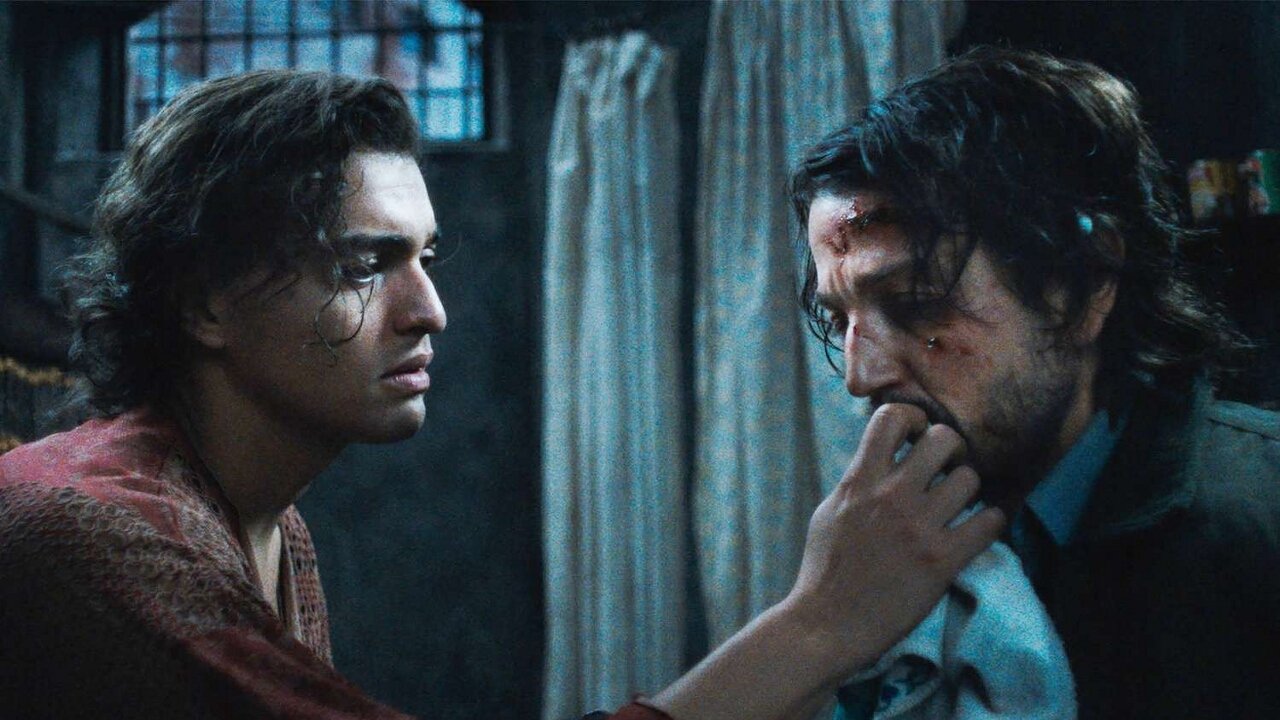
While numerous adaptations are expected of classic texts, few modern works have gotten more adaptations than Kiss of the Spider Woman.
Originally published in 1976, Manuel Puig’s novel follows the lives of two prisoners in an Argentine prison. One is a political prisoner, Valentín Arregui, whose information the fascist government wants. The other is a homosexual, Luis Molina, imprisoned for “corruption of a minor.” The government plants Molina with Arregui in hopes of befriending the activist and obtaining his information. The novel plays out as Molina regales Arregui with the storylines from his favorite movies as he slowly comes to care about Arregui and Arregui about him. However, ill-fated like one of the protagonists from his stories, tragedy is sure to follow but for whom?
The novel was first adapted into a stage play by Puig in 1983 starring Mark Rylance and Simon Callow in London but little is known about the production and its content. It was then adapted into feature film starring William Hurt in the Molina role and Raul Julia in the Arregui role, with the former winning an Oscar for his performance while the film was nominated but didn’t win for Best Picture, Directing, and Adapted Screenplay. Julia’s exclusion was quite the surprise. That film was set in Brazil during the military dictatorship there, which ended in 1985. In that production, it was a single film Molina recounts instead of several. Sônia Braga played Hollywood leading lady Aurora whose biggest cinematic role was a dual turn, which included the titular Spider Woman.
In 1992, the novel was again adapted to the stage in musical form with book by Terrence McNally and score by John Kander and lyricist Fred Ebb. Brent Carver played Molina and Anthony Crivello was Arregui but the film’s standout was Chita Rivera in the role of Aurora. A smash hit that earned the production 7 Tony awards out of 11 nominations with the Musical, McNally, Kander, Ebb, Rivera, Carver, and Crivello all winning. In that production, the events were moved back to Argentina, though in an unspecified timeframe.
In this most recent adaptation, the Argentine portion is set near the end of the Dirty War in 1983. Stepping into the Molina role is Tonatiuh, who, in only his third big screen role, delivers a tremendous breakthrough performance. Veteran Mexican actor Diego Luna plays Arregui and gives a solid performance in a role that requires a bit more vocal gravitas than he can muster. Jennifer Lopez takes on the role of Aurora, the star of the grand Hollywood production Molina describes with flair. Lopez is a gifted singer and her vocal performance is superb but it doesn’t quite feel like it comes from an emotive place. In her non-musical moments, there’s almost a glimmer of that old Hollywood idol magic but that has more to do with director Bill Condon and cinematographer Tobias A. Schliessler’s framing that gives her that appeal.
As far as musical adaptations go, this one works to an extent. It achieves the goal Condon had with his screenplay, taking away the song score from the prison-set moments and putting it all into the musical fantasias. That might punctuate the struggles and horrors of prison life but it robs the production of some of its excitement. Excising a large number of songs from the film cuts the runtime significantly but for however much thematic sense it makes, the film seems like it’s incomplete. The love story between Molina and Arregui feels rushed, this in spite of a two-plus-hour runtime.
Production designer Scott Chambliss and set decorator Andrew Baseman deserve much praise for the lavish, vibrant looks of the Hollywood film sets, an homage to technicolor that leaves no doubt about its inspirations. Combining this with Schliessler’s cinematography and you could be forgiven for mistaking those moments as cut directly from a film by Vincente Minnelli, or perhaps more fitting, Michael Powell and Emeric Pressburger. The gritty, dingy prison sequences stand at marked contrast, making the concept work despite its narrative limitations. Colleen Atwood and Christine L. Cantella make beautiful costumes, especially those in the Hollywood scenes but while they too look like they could have been pulled from Gigi or An American in Paris, the prison garb leaves a lot to be desired, blending too seamlessly into the grungy, cramped cell.
For a film that gets so many elements right, it’s a surprisingly unsuccessful adventure. Whereas Wicked embraced its queer support and remained largely faithful to the stage production, Kiss of the Spider Woman departs in ways that look acceptable on paper but in practice fail to impress. There are so many positive elements to the film that it seems a disservice to say that it doesn’t quite succeed. Kiss of the Spider Woman has a great anti-fascist premise, pro-LGBTQ messaging, and a tragically hopeful conclusion. Yet, what ends up on screen doesn’t even approach Condon’s admitted inspiration, Cabaret, better yet the more similar Chicago (which Condon adapted from another smash Broadway musical). Condon was too close to the material and the end result is something a bit more tragic than the film’s finale, a failure to fully live up to its potential.
Oscar Prospects
Potentials: Picture, Actor (Tonatiuh), Supporting Actress (Jennifer Lopez), Cinematography, Production Design, Costume Design, Sound
Review Written
November 18, 2025

















Leave a Reply