
The New Mutants
Rating

Director
Josh Boone
Screenplay
Josh Boone, Knate Lee
Length
1h 34m
Starring
Maisie Williams, Anya Taylor-Joy, Charlie Heaton, Alice Braga, Blu Hunt, Henry Zaga, Adam Beach
MPAA Rating
PG-13
Original Preview
Review
When superhero fatigue threatens to undo a lot of potential, a film like The New Mutants can feel like an uninspired, pointless attempt to cash in on a once-popular series with unique entry in the now-defunct Fox-Marvel universe.
The New Mutants was heavily advertised as a horror film set in the X-Men universe and, to an extent, that’s what it is. The inspiration it draws from A Nightmare on Elm Street 3: Dream Warriors is obvious but at the heart of the film is something a little less scary and a lot more contemplative than many will give it credit for.
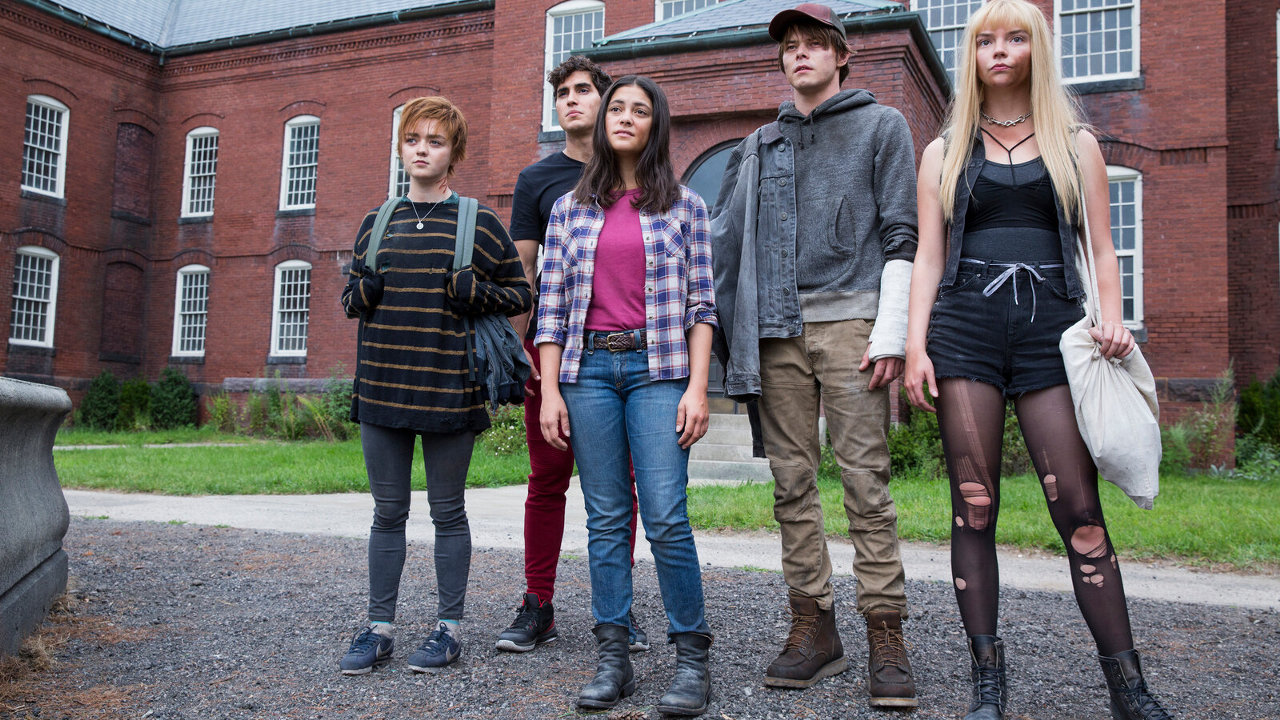
The story follows a quintet of young mutants who have been sequestered from society due to their uncontrollable powers. The film is ostensibly built around Dani Moonstar (Blu Hunt) whose introduction to the film involves a mysterious monster stalking her home village and killing everyone in its wake, including her father. The film’s narrative arc built around a story told to her by her father of two bears living inside her, one representing the good and one representing the evil, the feeding of which determines one’s character. Her powers appear to be psychic in foundation but whose true strength takes time to reveal itself.
Also housed at the facility are Rahne Sinclair (Maisie Williams) who has the ability to transform into a canine, Illyana Rasputina (Anya Taylor-Joy) who wields a magic sword and can travel through space via portal, Sam Guthrie (Charlie Heaton) who can travel at immense speeds, and Bobby DaCosta (Henry Zaga) who can elevate his body temperature to near sun-like heat. They are all being protected by forcefield manipulator Dr. Reyes (Alice Braga) who runs the former psychiatric facility, now research facility, in which they are living.
Each of these individuals faces a type of survivor’s guilt about their past actions. To a one, they are all responsible for the deaths of at least one person close to them. Like the kids in Dream Warriors, each has the ability to manifest powers to protect themselves from the threats around them but none of them are confident enough in their abilities (except Illyana) to control the great harm they conflict. Throw in the dark, dangerous, and persistent manifestations that stalk them through the facility and you have the horror elements that define the film.
Examining the undercurrent of the film require an understanding of the foundation on which the New Mutants and their counterparts the X-Men were built. In the 1970s, the series emerged as an allegory for racial, sexual, and countercultural movements in the United States with mutant powers standing in for these other immutable qualities the characters possessed and for which they were discriminated against. This film understood that assignment with its diverse casting.
Adding further support to this is the relationship between Dani and Rahne. In one the rare queer representations for main characters in the Marvel filmic universe (not to be mistaken for the MCU), the writers dug deep into this relationship to add thematic resonance to the film’s overarching theme. Throughout the film, Rahne’s character is developed as a self-discouraging mutant whose Catholic upbringing has challenged her faith in her own value. This is referenced a few times, most notably with an encounter in the church where she’s giving her confession to no one and then in the film’s climactic scene (I go into more detail in the spoiler section below).
Although the film can be lauded for its progressive metaphorical elements, it does have a handful of issues, not the least of which are the underwhelming performances by the cast. Some (Williams and Heaton) drift in and out of their accents at odd times) while others deliver borderline bad performances (Zaga, Braga). Then you have Taylor-Joy who is clearly hamming it up as a prototypical antagonist whose extreme self assurance masks a deep insecurity. While she could have done something a little less showy or exaggerated, it might not have had the emotional impact it should in one of several trope-laden moments in the film.
The New Mutants is a film of contrasting quality. Apart from the unimpressive acting, the film is incredibly well made. The effects are stellar, the production design is compelling, and its metaphor-juggling elements make for a thought provoking discussion. That uneven tone hinders its ability to pull the X-Men series from the brink of destruction (heralded by the merger of Disney and Fox) and unfortunately created an environment where the wonderful characters of the film will be forgotten when it comes time to reboot the franchise as part of the Marvel Cinematic Universe. For horror fans, the film is sure to be somewhat disappointing. The terrifying elements are less exciting than they should be and the slasher elements that are suggested by the Elm Street connection don’t stand out enough. Still, for fans of the X-Men looking for something a little different, this could be a decent time filler even if it doesn’t end up as anyone’s favorite film of the year.
Spoiler Discussion
The scene that cemented this as one of the more thought provoking and inventive films in the X-Men universe, is the final battle of the picture. The conflict involves the destruction of the church set where many earlier segments take place. It’s in this moment that a metaphorical battle occurs. The burgeoning relationship between Dani and Rahne is given ample attention both through the foreshadowing of the Sapphic kissing scene in Buffy the Vampire Slayer and the actual act that marks the shift from the film’s second to third act. Although her mutant abilities are ostensibly the cause of her crisis of faith, it’s clear her queer nature is the allegory on offer.
This culminates in the final scene where Dani’s gargantuan psychic manifestation of her inner bear demon, who lays waste to the church in the film, becomes a compelling metaphor for Rahne’s ultimate act of tearing down Rahne’s self-doubt and destroying the religious foundation of that. This is the kind of scene that most audiences won’t understand without having their attention drawn to it. For superhero action films, climactic battles are always highly destructive and emotional events but seldom are they this tinged with philosophical concepts that elevate the notion beyond typical apocalyptic theatrics.
Review Written
August 4, 2026

















Leave a Reply